
Join Our JEE Preparation Group
Prep with like-minded aspirants; Get access to free daily tests and study material.
Sign in
Please select an account to continue using cracku.in
↓ →
Join Our JEE Preparation Group
Prep with like-minded aspirants; Get access to free daily tests and study material.
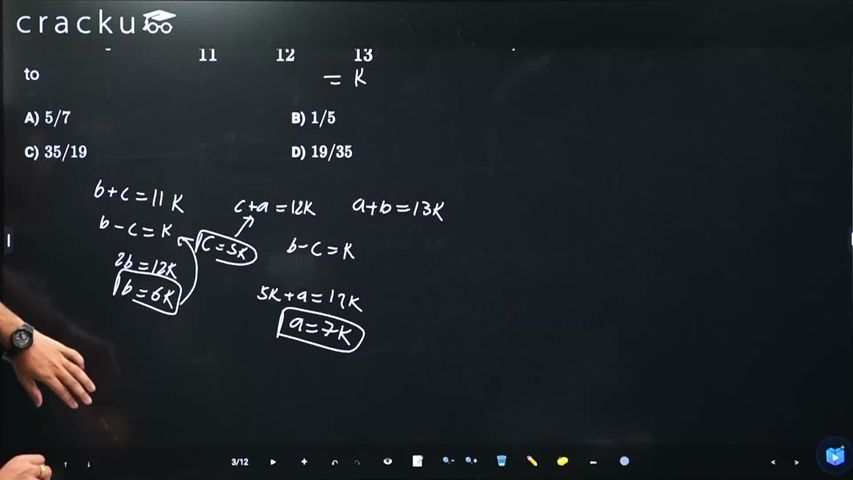
If in a triangle $$ABC$$, $$\dfrac{b+c}{11} = \dfrac{c+a}{12} = \dfrac{a+b}{13}$$, then $$\cos A$$ is equal to
Let the side lengths opposite to angles $$A,B,C$$ be $$a,b,c$$ respectively. The condition given is
$$\frac{b+c}{11}=\frac{c+a}{12}=\frac{a+b}{13}=k,$$
where $$k$$ is a positive constant (because all sides are positive). From this we obtain three linear equations:
$$b+c = 11k \quad -(1)$$
$$c+a = 12k \quad -(2)$$
$$a+b = 13k \quad -(3)$$
First, add equations $$(1)$$ and $$(2)$$:
$$b+c + c+a = 11k + 12k \; \Rightarrow \; a+b+2c = 23k \quad -(4)$$
Subtract equation $$(3)$$ from $$(4)$$ to isolate $$c$$:
$$(a+b+2c) - (a+b) = 23k - 13k \; \Rightarrow \; 2c = 10k \; \Rightarrow \; c = 5k.$$
Insert $$c = 5k$$ into equation $$(2)$$ to get $$a$$:
$$5k + a = 12k \; \Rightarrow \; a = 7k.$$
Insert $$a = 7k$$ into equation $$(3)$$ to get $$b$$:
$$7k + b = 13k \; \Rightarrow \; b = 6k.$$
Hence the side lengths are proportional to $$7:6:5$$, i.e.
$$a = 7k,\; b = 6k,\; c = 5k.$$
To find $$\cos A$$, use the Law of Cosines:
$$\cos A = \frac{b^{2}+c^{2}-a^{2}}{2bc}.$$
Substitute the obtained side lengths:
$$\cos A = \frac{(6k)^{2} + (5k)^{2} - (7k)^{2}}{2\,(6k)\,(5k)} = \frac{36k^{2} + 25k^{2} - 49k^{2}}{60k^{2}} = \frac{12k^{2}}{60k^{2}} = \frac{1}{5}.$$
Therefore, $$\cos A = \dfrac{1}{5}.$$
Was this solution helpful?
Click on the Email ☝️ to Watch the Video Solution
Create a FREE account and get:
_1.webp)

Educational materials for JEE preparation

Ask our AI anything

AI can make mistakes. Please verify important information.
AI can make mistakes. Please verify important information.
