
Join Our JEE Preparation Group
Prep with like-minded aspirants; Get access to free daily tests and study material.
Sign in
Please select an account to continue using cracku.in
↓ →
Join Our JEE Preparation Group
Prep with like-minded aspirants; Get access to free daily tests and study material.
Phosphorus pentachloride dissociates as follows, in a closed reaction vessel, $$PCl_5(g) \rightleftharpoons PCl_3(g) + Cl_2(g)$$ If total pressure at equilibrium of the reaction mixture is $$P$$ and degree of dissociation of $$PCl_5$$ is $$x$$, the partial pressure of $$PCl_3$$ will be
Write the dissociation equilibrium:
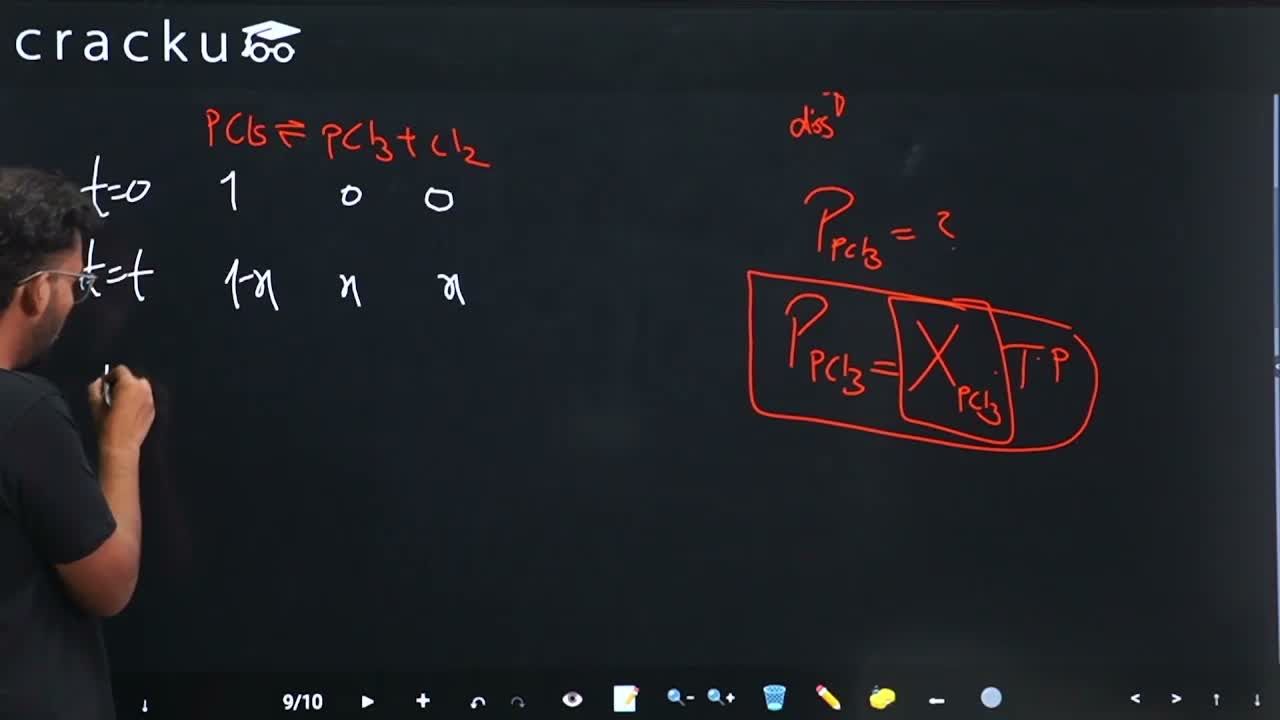
$$PCl_5(g) \rightleftharpoons PCl_3(g) + Cl_2(g)$$
Assume we start with 1 mol of $$PCl_5$$ in a closed vessel and none of the products.
If the degree of dissociation is $$x$$, then $$x$$ mol of $$PCl_5$$ break up. At equilibrium:
• Moles of $$PCl_5 = 1 - x$$
• Moles of $$PCl_3 = x$$
• Moles of $$Cl_2 = x$$
Total number of moles at equilibrium:
$$n_{\text{total}} = (1 - x) + x + x = 1 + x$$
The total pressure of the gaseous mixture is given as $$P$$.
Hence the mole fraction of $$PCl_3$$ is
$$\chi_{PCl_3} = \frac{\text{moles of }PCl_3}{n_{\text{total}}} = \frac{x}{1 + x}$$
Partial pressure is mole fraction multiplied by total pressure:
$$P_{PCl_3} = \chi_{PCl_3}\,P = \left(\frac{x}{1 + x}\right)P$$
Therefore the required partial pressure equals $$\left(\dfrac{x}{x+1}\right)P$$.
Option A is correct.
Was this solution helpful?
Click on the Email ☝️ to Watch the Video Solution
Create a FREE account and get:
_1.webp)

Educational materials for JEE preparation

Ask our AI anything

AI can make mistakes. Please verify important information.
AI can make mistakes. Please verify important information.
