
Join Our JEE Preparation Group
Prep with like-minded aspirants; Get access to free daily tests and study material.
Sign in
Please select an account to continue using cracku.in
↓ →
Join Our JEE Preparation Group
Prep with like-minded aspirants; Get access to free daily tests and study material.
The question asks for the INCORRECT statement among the four given reactions of p-block elements.
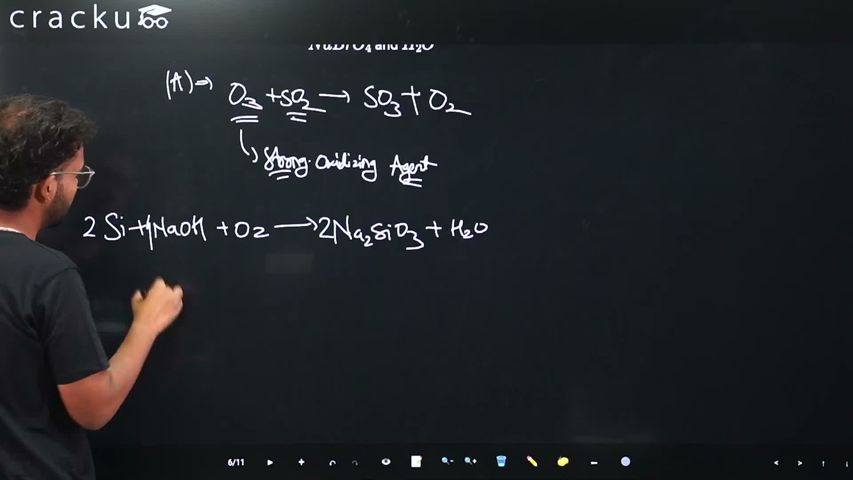
Case A: $$\displaystyle O_3 + SO_2 \rightarrow SO_3 + O_2$$
Ozone is a strong oxidising agent; it oxidises $$SO_2$$ to $$SO_3$$ while itself getting reduced to $$O_2$$.
This reaction is standard and correct.
Case B: Reaction of silicon with aqueous $$NaOH$$ in the presence of air Silicon is first attacked by hydroxide ion; the oxygen present in air then completes the oxidation to silicate:
$$\displaystyle 2\,Si + 4\,NaOH + O_2 \;\longrightarrow\; 2\,Na_2SiO_3 + 2\,H_2O$$
The products are sodium silicate and water, exactly as stated. Hence statement B is correct.
Case C: Reaction of chlorine with excess ammonia With a large excess of $$NH_3$$, chlorine is reduced to chloride while ammonia is oxidised to nitrogen:
$$\displaystyle 3\,Cl_2 + 8\,NH_3 \;\longrightarrow\; N_2 + 6\,NH_4Cl$$
The products are $$N_2$$ and $$HCl$$ in combined form as ammonium chloride; therefore statement C is also correct.
Case D: Reaction of bromine with hot, concentrated $$NaOH$$ A disproportionation occurs, but the oxidation product is bromate (BrO$$_3^-$$), not perbromate (BrO$$_4^-$$):
$$\displaystyle 3\,Br_2 + 6\,NaOH \;\xrightarrow[\text{hot}]{\text{conc}} 5\,NaBr + NaBrO_3 + 3\,H_2O$$
No $$NaBrO_4$$ (sodium perbromate) is formed under these conditions. Therefore statement D is incorrect.
Hence, the only incorrect statement is:
Option D which is: $$Br_2$$ reacts with hot and strong $$NaOH$$ solution to give $$NaBr$$, $$NaBrO_4$$ and $$H_2O$$.
Was this solution helpful?
Click on the Email ☝️ to Watch the Video Solution
Create a FREE account and get:
_1.webp)

Educational materials for JEE preparation

Ask our AI anything

AI can make mistakes. Please verify important information.
AI can make mistakes. Please verify important information.
