
Join Our JEE Preparation Group
Prep with like-minded aspirants; Get access to free daily tests and study material.
Sign in
Please select an account to continue using cracku.in
↓ →
Join Our JEE Preparation Group
Prep with like-minded aspirants; Get access to free daily tests and study material.
Two blocks of masses 3 kg and 5 kg are connected by a metal wire going over a smooth pulley. The breaking stress of the metal is $$\frac{24}{\pi} \times 10^2$$ N m$$^{-2}$$. What is the minimum radius of the wire?
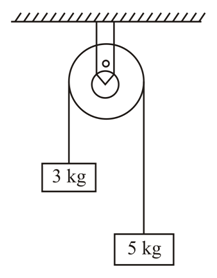
(take g = 10 m s$$^{-2}$$)
We need to determine the minimum radius of the metal wire supporting two suspended masses in an Atwood machine setup without exceeding its breaking stress.
From the problem , the system consists of two masses connected across a smooth pulley by a metal wire:
For a standard ideal pulley system containing two unequal masses, the dynamic tension ($$T$$) developed in the connecting string while the blocks are in motion is given by the formula:
$$T = \frac{2 m_1 m_2}{m_1 + m_2} g$$
Substituting the given mass values and acceleration due to gravity:
$$T = \frac{2 \times 3 \times 5}{3 + 5} \times 10 = \frac{30}{8} \times 10 = \frac{300}{8} = 37.5\text{ N}$$
The internal mechanical stress experienced by a wire of a circular cross-section is defined as the restoring force per unit area. To prevent the wire from snapping, the operational stress must not exceed the breaking limit:
$$\sigma_{\text{breaking}} = \frac{\text{Tension}}{\text{Cross-sectional Area}} = \frac{T}{\pi r^2}$$
Rearranging the expression to solve for the radius ($$r$$):
$$r^2 = \frac{T}{\pi \cdot \sigma_{\text{breaking}}}$$
Substituting the computed values of tension ($$T = 37.5\text{ N}$$) and breaking stress into the equation:
$$r^2 = \frac{37.5}{\pi \times \left(\frac{24}{\pi} \times 10^2\right)} = \frac{37.5}{24 \times 10^2} = \frac{1.5625}{10^2} = 0.015625\text{ m}^2$$
Taking the square root on both sides to find the radius in meters:
$$r = \sqrt{0.015625} = 0.125\text{ m}$$
To match the final options provided in the problem layout, we convert the minimum required radius from meters to centimeters ($$1\text{ m} = 100\text{ cm}$$):
$$r = 0.125 \times 100\text{ cm} = 12.5\text{ cm}$$
The minimum radius of the wire required to support the moving masses without breaking is 12.5 cm.
Was this solution helpful?
Create a FREE account and get:
_1.webp)

Educational materials for JEE preparation

Ask our AI anything

AI can make mistakes. Please verify important information.
AI can make mistakes. Please verify important information.
