
Join Our JEE Preparation Group
Prep with like-minded aspirants; Get access to free daily tests and study material.
Sign in
Please select an account to continue using cracku.in
↓ →
Join Our JEE Preparation Group
Prep with like-minded aspirants; Get access to free daily tests and study material.
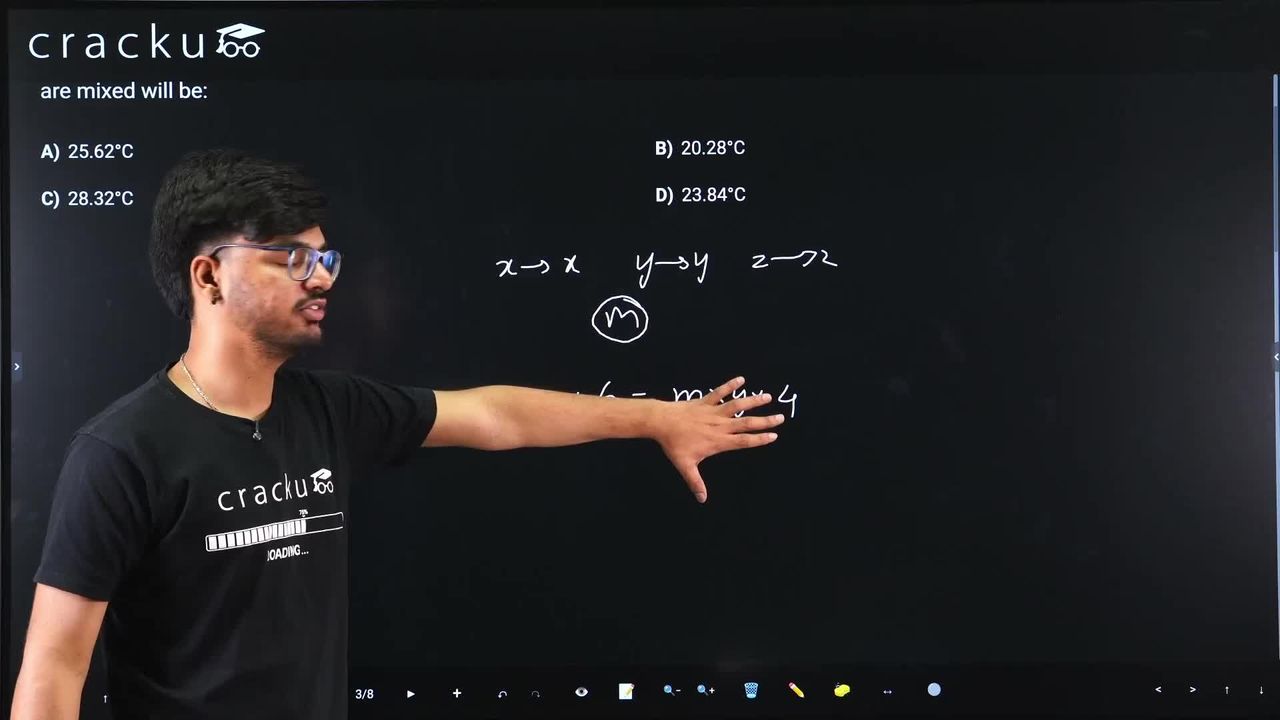
The temperature of equal masses of three different liquids $$x$$, $$y$$ and $$z$$ are 10°C, 20°C and 30°C respectively. The temperature of mixture when $$x$$ is mixed with $$y$$ is 16°C and that when $$y$$ is mixed with $$z$$ is 26°C. The temperature of mixture when $$x$$ and $$z$$ are mixed will be:
Let the masses of the liquids be equal and equal to $$m$$. Denote their specific heats by $$c_x,\;c_y,\;c_z$$ and their initial temperatures by $$T_x = 10^\circ\text{C},\;T_y = 20^\circ\text{C},\;T_z = 30^\circ\text{C}$$ respectively.
Whenever two liquids are mixed adiabatically, the heat lost by the hotter liquid equals the heat gained by the colder one. Mathematically we write
$$\text{Heat lost} = \text{Heat gained}.$$
For equal masses this becomes
$$m c_{\text{hot}}\,(T_{\text{hot}}-T_f)=m c_{\text{cold}}\,(T_f-T_{\text{cold}}),$$
where $$T_f$$ is the final (equilibrium) temperature of the mixture.
First we mix liquids $$x$$ and $$y$$. Their final temperature is given to be $$16^\circ\text{C}$$. Here $$x$$ is colder and $$y$$ is hotter, so
$$m c_x\,(16-10)=m c_y\,(20-16).$$
Cancelling the common mass $$m$$ and substituting the numerical differences, we have
$$c_x\,(6)=c_y\,(4).$$
Dividing both sides by 2 gives
$$3c_x=2c_y,$$
which rearranges to
$$c_y=\frac{3}{2}\,c_x.$$
Hence the specific heat of liquid $$y$$ is $$1.5$$ times that of liquid $$x$$.
Next we mix liquids $$y$$ and $$z$$. Their final temperature is given to be $$26^\circ\text{C}$$. Again applying the heat‐balance relation, with $$y$$ colder and $$z$$ hotter, we get
$$m c_y\,(26-20)=m c_z\,(30-26).$$
After cancelling the mass $$m$$ and inserting the numerical differences, this becomes
$$c_y\,(6)=c_z\,(4).$$
So we have
$$6c_y=4c_z \quad\Longrightarrow\quad c_z=\frac{6}{4}\,c_y=\frac{3}{2}\,c_y.$$
We already found $$c_y=\frac{3}{2}\,c_x$$, so substituting this value we get
$$c_z=\frac{3}{2}\left(\frac{3}{2}c_x\right)=\frac{9}{4}\,c_x=2.25\,c_x.$$
Finally we mix liquids $$x$$ and $$z$$. Let the required equilibrium temperature be $$T_f$$. Liquid $$x$$ is colder and liquid $$z$$ is hotter, hence
$$m c_x\,(T_f-10)=m c_z\,(30-T_f).$$
Cancelling the common factor $$m$$ and substituting $$c_z=2.25\,c_x$$ gives
$$c_x\,(T_f-10)=2.25\,c_x\,(30-T_f).$$
Since $$c_x\neq 0$$, it can be divided out, leaving
$$T_f-10=2.25\,(30-T_f).$$
Expanding the right side, we have
$$T_f-10=2.25\times30-2.25\,T_f.$$
Calculating the product, $$2.25\times30=67.5$$, so
$$T_f-10 = 67.5 - 2.25T_f.$$
Now collect the $$T_f$$ terms on the left and the constants on the right:
$$T_f + 2.25T_f = 67.5 + 10.$$
This simplifies to
$$3.25T_f = 77.5.$$
Dividing both sides by $$3.25$$, we obtain
$$T_f = \frac{77.5}{3.25}.$$
Carrying out the division gives
$$T_f = 23.846\ldots^\circ\text{C} \approx 23.84^\circ\text{C}.$$
Hence, the correct answer is Option D.
Was this solution helpful?
Click on the Email ☝️ to Watch the Video Solution
Create a FREE account and get:
_1.webp)

Educational materials for JEE preparation

Ask our AI anything

AI can make mistakes. Please verify important information.
AI can make mistakes. Please verify important information.
