
Join Our JEE Preparation Group
Prep with like-minded aspirants; Get access to free daily tests and study material.
Sign in
Please select an account to continue using cracku.in
↓ →
Join Our JEE Preparation Group
Prep with like-minded aspirants; Get access to free daily tests and study material.
The solid cylinder of length 80 cm and mass $$M$$ has a radius of 20 cm. Calculate the density of the material used if the moment of inertia of the cylinder about an axis $$CD$$ parallel to $$AB$$ as shown in figure is 2.7 kg m$$^2$$.
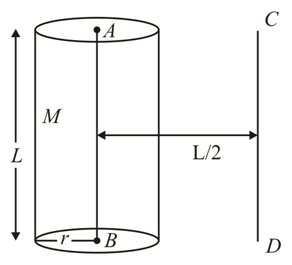
We need to calculate the density of the material used in a solid cylinder given its length, radius, and the moment of inertia about a parallel axis $$CD$$.
The axis $$AB$$ is the central longitudinal axis of the solid cylinder. The moment of inertia of a uniform solid cylinder of mass $$M$$ and radius $$r$$ about its own longitudinal axis is:
$$I_{AB} = \frac{1}{2} M r^2$$
According to the Parallel Axis Theorem, the moment of inertia about an axis $$CD$$ parallel to $$AB$$ at a distance $$d$$ is given by:
$$I_{CD} = I_{AB} + M d^2$$
Substituting the expression for $$I_{AB}$$ and the value of $$d = \frac{L}{2}$$:
$$I_{CD} = \frac{1}{2} M r^2 + M \left(\frac{L}{2}\right)^2$$
$$I_{CD} = M \left( \frac{r^2}{2} + \frac{L^2}{4} \right)$$
Substitute the numerical values of $$I_{CD}$$, $$r$$, and $$L$$ into the equation to find $$M$$:
$$2.7 = M \left( \frac{(0.2)^2}{2} + \frac{(0.8)^2}{4} \right)$$
$$2.7 = M \left( \frac{0.04}{2} + \frac{0.64}{4} \right)$$
$$2.7 = M (0.02 + 0.16)$$
$$2.7 = M (0.18)$$
$$M = \frac{2.7}{0.18} = \frac{270}{18} = 15\text{ kg}$$
The volume ($$V$$) of a solid cylinder is calculated using the geometry formula:
$$V = \pi r^2 L$$
$$V = 3.1416 \times (0.2)^2 \times 0.8$$
$$V = 3.1416 \times 0.04 \times 0.8 = 3.1416 \times 0.032 \approx 0.10053\text{ m}^3$$
Now, density ($$\rho$$) is defined as mass per unit volume:
$$\rho = \frac{M}{V}$$
$$\rho = \frac{15}{0.10053} \approx 149.2\text{ kg m}^{-3}$$
Expressing the result in standard scientific notation matches the required formatting:
$$\rho \approx 1.49 \times 10^2\text{ kg m}^{-3}$$
Final Answer: Option A ($$1.49 \times 10^2\text{ kg m}^{-3}$$)
Was this solution helpful?
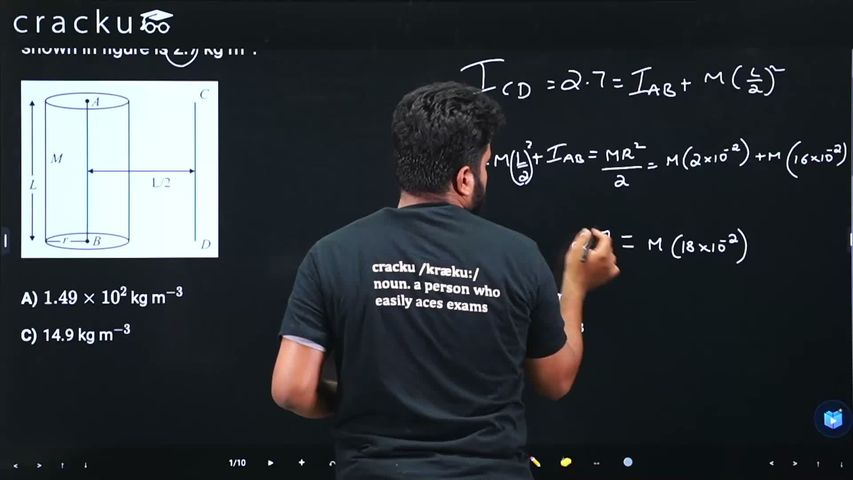
Click on the Email ☝️ to Watch the Video Solution
Create a FREE account and get:
_1.webp)

Educational materials for JEE preparation

Ask our AI anything

AI can make mistakes. Please verify important information.
AI can make mistakes. Please verify important information.
