
Join Our JEE Preparation Group
Prep with like-minded aspirants; Get access to free daily tests and study material.
Sign in
Please select an account to continue using cracku.in
↓ →
Join Our JEE Preparation Group
Prep with like-minded aspirants; Get access to free daily tests and study material.
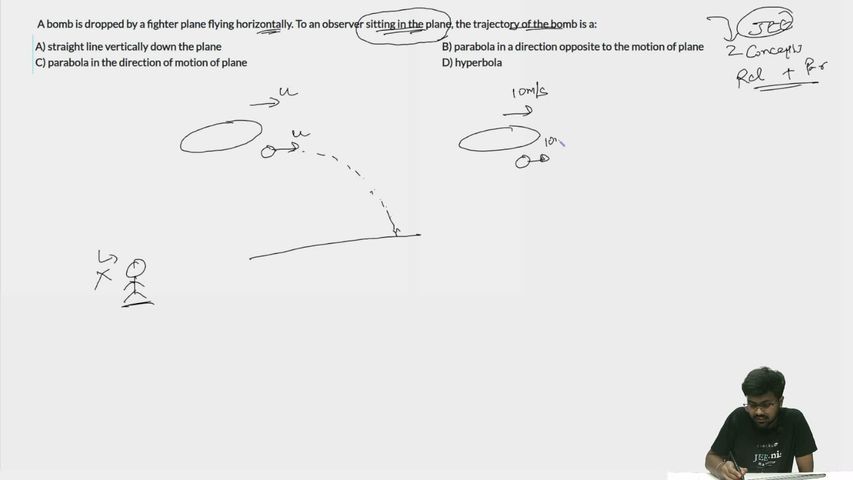
A bomb is dropped by a fighter plane flying horizontally. To an observer sitting in the plane, the trajectory of the bomb is a:
Let us fix an $$x$$-$$y$$ coordinate system that, at the instant the bomb leaves the aircraft, has its origin at the bomb itself. The $$x$$-axis is chosen horizontally in the direction in which the plane is flying, while the $$y$$-axis is chosen vertically upward (opposite to the direction of gravity). The positive $$y$$ direction is therefore upward and the acceleration due to gravity acts downward, that is, along the negative $$y$$ direction with magnitude $$g$$.
First, we write the equations of motion of the bomb as seen by an observer on the ground (an inertial frame). Because the plane is flying horizontally with constant speed $$u$$, the bomb, at the moment of release, possesses the same horizontal speed $$u$$. Therefore, in the ground frame, the initial conditions are
$$x(0)=0, \qquad y(0)=0,$$
$$\dot x(0)=u, \qquad \dot y(0)=0,$$
and the only acceleration acting on the bomb is gravitational:
$$\ddot x = 0, \qquad \ddot y = -g.$$
Integrating these with respect to time $$t$$, we obtain the bomb’s position in the ground frame:
Horizontal motion:
$$\ddot x = 0 \;\Rightarrow\; \dot x = u \quad(\text{since }\dot x(0)=u),$$
Integrating once more,
$$x(t)=ut.$$
Vertical motion:
$$\ddot y = -g \;\Rightarrow\; \dot y = -gt \quad(\text{since }\dot y(0)=0),$$
Integrating again,
$$y(t) = -\tfrac{1}{2}gt^{2}.$$
Eliminating the time $$t$$ between $$x(t)$$ and $$y(t)$$, we get
$$t = \frac{x}{u}\quad\Longrightarrow\quad y = -\tfrac{1}{2}g\left(\frac{x}{u}\right)^{2},$$
or
$$y = -\frac{g}{2u^{2}}\,x^{2}.$$
This is the standard equation of a parabola opening downward, confirming that in the ground frame the bomb follows a parabolic path.
Now we must determine what the observer inside the plane sees. The plane itself forms a non-inertial (moving) frame that translates with the constant horizontal velocity $$u$$. According to Galilean relativity, to convert coordinates from the ground frame $$(x,y)$$ to the plane’s frame $$(x',y')$$, we subtract the uniform motion of the plane:
$$x' = x - ut, \qquad y' = y.$$
Substituting $$x = ut$$ from the earlier result, we find
$$x' = ut - ut = 0.$$
Thus, at every instant of time,
$$x' = 0.$$
The vertical coordinate, on the other hand, remains exactly what it was in the ground frame because the transformation does not affect $$y$$:
$$y' = y = -\tfrac{1}{2}gt^{2}.$$
Therefore the equations of motion in the plane’s frame reduce to
$$x'(t) = 0,\qquad y'(t) = -\tfrac{1}{2}gt^{2}.$$
Because $$x'$$ is identically zero at all times, the bomb has no horizontal motion relative to the plane. Its entire motion, as perceived by the observer sitting in the aircraft, consists solely of a uniform downward acceleration under gravity.
Consequently, the bomb appears to fall straight down along the vertical line that passes through the point of release. This straight vertical line is precisely Option A in the given list.
Hence, the correct answer is Option A.
Was this solution helpful?
Click on the Email ☝️ to Watch the Video Solution
Create a FREE account and get:
_1.webp)

Educational materials for JEE preparation

Ask our AI anything

AI can make mistakes. Please verify important information.
AI can make mistakes. Please verify important information.
