
Join Our JEE Preparation Group
Prep with like-minded aspirants; Get access to free daily tests and study material.
Sign in
Please select an account to continue using cracku.in
↓ →
Join Our JEE Preparation Group
Prep with like-minded aspirants; Get access to free daily tests and study material.
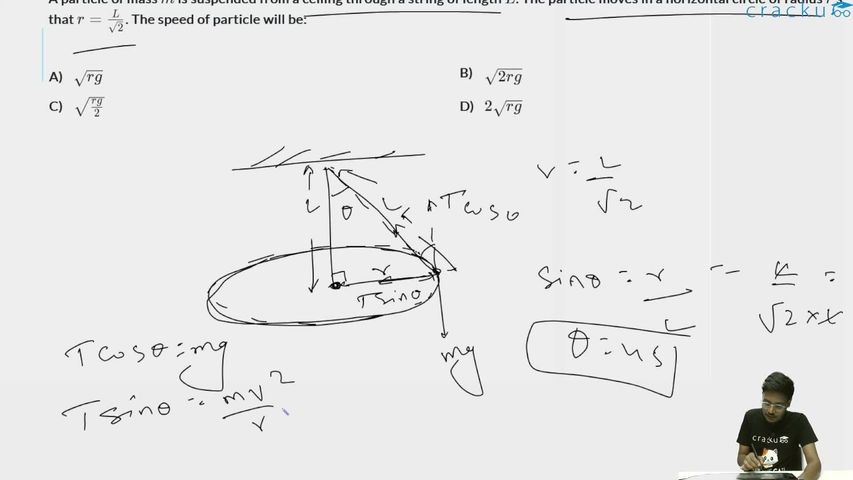
A particle of mass $$m$$ is suspended from a ceiling through a string of length $$L$$. The particle moves in a horizontal circle of radius $$r$$ such that $$r = \frac{L}{\sqrt{2}}$$. The speed of particle will be:
Let us denote by $$\theta$$ the constant angle that the string makes with the vertical while the particle is executing uniform circular motion in a horizontal plane. Because the string has length $$L$$ and the horizontal projection of that length is the radius $$r$$, simple right-triangle geometry gives
$$\sin\theta \;=\;\frac{\text{opposite side}}{\text{hypotenuse}}\;=\;\frac{r}{L}.$$
We are told that $$r=\dfrac{L}{\sqrt2}$$, so
$$\sin\theta \;=\;\frac{L/\sqrt2}{L}\;=\;\frac1{\sqrt2}.$$
The value $$\sin\theta=\dfrac1{\sqrt2}$$ corresponds to
$$\theta=45^\circ,\qquad\text{and hence}\qquad \cos\theta=\frac1{\sqrt2},\qquad\tan\theta=1.$$
Now we analyse the forces on the particle. Two forces act: its weight $$mg$$ vertically downward and the tension $$T$$ along the string at an angle $$\theta$$ from the vertical. We resolve the tension into horizontal and vertical components.
Vertical equilibrium: the particle neither rises nor falls, so the vertical components balance. Thus
$$T\cos\theta \;=\;mg\quad\text{(1)}.$$
Horizontal motion: the particle executes uniform circular motion of radius $$r$$, so the required centripetal force is provided by the horizontal component of the tension. Using the standard centripetal‐force formula $$F_c=\dfrac{mv^2}{r}$$, we write
$$T\sin\theta \;=\;\frac{mv^2}{r}\quad\text{(2)}.$$
From equation (1) we solve for the tension:
$$T=\frac{mg}{\cos\theta}.$$
We substitute this value of $$T$$ into equation (2):
$$\frac{mg}{\cos\theta}\;\sin\theta \;=\;\frac{mv^2}{r}.$$
Cancel the common factor $$m$$ and rearrange step by step:
$$g\,\frac{\sin\theta}{\cos\theta}\;=\;\frac{v^2}{r},$$
$$g\,\tan\theta \;=\;\frac{v^2}{r},$$
$$v^2 \;=\;r\,g\,\tan\theta.$$
We already found $$\tan\theta=1$$, so
$$v^2=r\,g\,(1)=r\,g.$$
Taking the positive square root gives the speed:
$$v=\sqrt{r\,g}.$$
This matches Option A. Hence, the correct answer is Option A.
Was this solution helpful?
Click on the Email ☝️ to Watch the Video Solution
Create a FREE account and get:
_1.webp)

Educational materials for JEE preparation

Ask our AI anything

AI can make mistakes. Please verify important information.
AI can make mistakes. Please verify important information.
