
Join Our JEE Preparation Group
Prep with like-minded aspirants; Get access to free daily tests and study material.
Sign in
Please select an account to continue using cracku.in
↓ →
Join Our JEE Preparation Group
Prep with like-minded aspirants; Get access to free daily tests and study material.
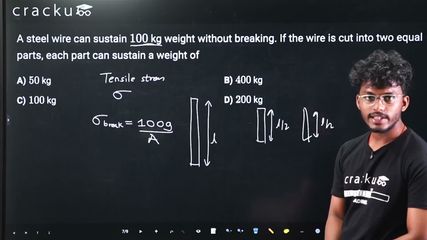
A steel wire can sustain $$100$$ kg weight without breaking. If the wire is cut into two equal parts, each part can sustain a weight of
Breaking of a wire occurs when the tensile stress in the material reaches its ultimate (breaking) stress. Breaking stress is a material property; it does not depend on the length of the wire but only on the nature of the material and its cross-sectional area.
For the original steel wire:
maximum load $$W_{\max} = 100 \text{ kgf}$$ (where $$1 \text{ kgf}=g \text{ newton}$$).
Corresponding breaking stress is
$$\sigma_{\text{break}} = \frac{W_{\max} \, g}{A},$$
where $$A$$ is the wire’s cross-sectional area.
If the wire is cut into two equal halves, the length becomes $$\tfrac{1}{2}$$ of the original, but the cross-sectional area $$A$$ remains unchanged. Under any load $$W$$ the tensile stress in either half is still $$\sigma = \dfrac{W\,g}{A}$$, the same formula as before.
Because the breaking stress of steel is unchanged and the area is unchanged, the maximum load that produces this critical stress is also unchanged. Hence each half can sustain the same load of $$100 \text{ kgf}$$ before breaking.
Therefore, each part can sustain a weight of 100 kg.
Option C which is: $$100 \text{ kg}$$
Was this solution helpful?
Click on the Email ☝️ to Watch the Video Solution
Create a FREE account and get:
_1.webp)

Educational materials for JEE preparation

Ask our AI anything

AI can make mistakes. Please verify important information.
AI can make mistakes. Please verify important information.
