
Join Our JEE Preparation Group
Prep with like-minded aspirants; Get access to free daily tests and study material.
Sign in
Please select an account to continue using cracku.in
↓ →
Join Our JEE Preparation Group
Prep with like-minded aspirants; Get access to free daily tests and study material.
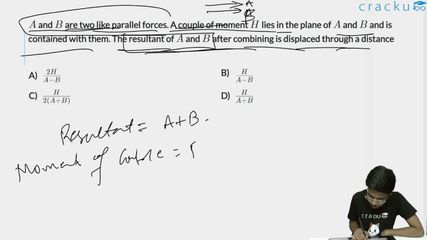
$$A$$ and $$B$$ are two like parallel forces. A couple of moment $$H$$ lies in the plane of $$A$$ and $$B$$ and is contained with them. The resultant of $$A$$ and $$B$$ after combining is displaced through a distance
We are given two like parallel forces, $$A$$ and $$B$$. "Like" parallel forces act in the exact same direction along parallel lines of action.
The resultant ($$R$$) of two like parallel forces is simply the algebraic sum of their magnitudes, and it acts in the same direction:
$$R = A + B$$
Initially, this resultant force $$R$$ passes through a specific point (let's call it $$C$$) on the line segment connecting the points of application of forces $$A$$ and $$B$$, satisfying the principle of moments: $$A \cdot AC = B \cdot BC$$.
A coplanar couple of moment $$H$$ is introduced into the plane containing forces $$A$$ and $$B$$.
In rigid-body mechanics, a couple consists of two equal and opposite forces whose net translational force vector is exactly zero. Therefore, adding a couple to a system of forces does not alter the net total force magnitude or direction of the system. The new overall resultant force ($$R'$$) must still be:
$$R' = A + B$$
While the couple doesn't change the magnitude of the total resultant force, its rotational moment shifts the position where the net force effectively acts.
To find the perpendicular distance ($$d$$) by which the line of action of the resultant shifts to balance out the extra torque introduced by the couple, we use the foundational relationship between a force, a displacement, and a couple's moment:
$$\text{Moment of the Couple} = \text{Resultant Force} \times \text{Displacement}$$
$$H = R \cdot d$$
Substitute the value of the combined resultant force ($$R = A + B$$) into the expression:
$$H = (A + B) \cdot d$$
Isolating the displacement variable ($$d$$):
$$d = \frac{H}{A + B}$$
Concept Check: Introducing a pure rotational moment $$H$$ to a system with an existing net translational force $(A+B)$ creates a structural torque imbalance. To restore equivalence without changing the net force magnitude, the entire translational force vector must slide sideways by a distance inversely proportional to the system's total linear strength.
Correct Option Key: Option D ($$\frac{H}{A+B}$$)
Was this solution helpful?
Click on the Email ☝️ to Watch the Video Solution
Create a FREE account and get:
_1.webp)

Educational materials for JEE preparation

Ask our AI anything

AI can make mistakes. Please verify important information.
AI can make mistakes. Please verify important information.
