
Join Our JEE Preparation Group
Prep with like-minded aspirants; Get access to free daily tests and study material.
Sign in
Please select an account to continue using cracku.in
↓ →
Join Our JEE Preparation Group
Prep with like-minded aspirants; Get access to free daily tests and study material.
Consider the following reactions. Total number of electrons in the $$\pi$$ bonds and lone pair of electrons in the product (X) is :
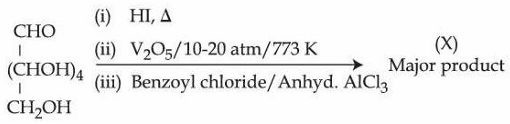
Glucose undergoes a series of reactions to give the final product (X).
On treatment with excess (HI) and heating, all the hydroxyl groups and the aldehyde group present in glucose are reduced, producing (n)-hexane.
$$C_6H_{12}O_6 \xrightarrow{HI,\ \Delta} CH_3(CH_2)_4CH_3$$
The (n)-hexane obtained is then subjected to catalytic oxidation in the presence of (V_2O_5) at (773,K), which results in dehydrocyclization to form benzene.
$$CH_3(CH_2)_4CH_3 \xrightarrow{V_2O_5,\ 773,K} C_6H_6$$
Finally, benzene undergoes Friedel-Crafts acylation with benzoyl chloride in the presence of anhydrous (AlCl_3) to produce benzophenone.
$$C_6H_6 \xrightarrow{C_6H_5COCl/AlCl_3} C_6H_5COC_6H_5$$
Hence, the final product (X) is benzophenone.
To determine the total number of electrons present in its (\pi)-bonds and lone pairs, consider its structure:
Thus, the total number of (\pi)-bonds is
$$6+1=7.$$
Since each (\pi)-bond contains (2) electrons,
$$\text{Total }\pi\text{ electrons}=7\times2=14.$$
The oxygen atom of the carbonyl group possesses two lone pairs, contributing
$$2\times2=4\text{ electrons}.$$
Therefore, the total number of electrons present in the (\pi)-bonds and lone pairs is
$$14+4=18.$$
Hence, the correct answer is 18.
Was this solution helpful?
Click on the Email ☝️ to Watch the Video Solution
Create a FREE account and get:
_1.webp)

Educational materials for JEE preparation

Ask our AI anything

AI can make mistakes. Please verify important information.
AI can make mistakes. Please verify important information.
