Join Our JEE Preparation Group
Prep with like-minded aspirants; Get access to free daily tests and study material.
Sign in
Please select an account to continue using cracku.in
↓ →
Join Our JEE Preparation Group
Prep with like-minded aspirants; Get access to free daily tests and study material.
To determine the major product of the given intramolecular aldol condensation, we analyze the structure of the starting material and the possible cyclization pathways available under basic conditions.
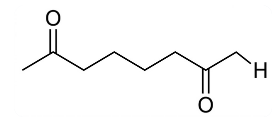
The starting compound is 6-oxoheptanal, which contains both an aldehyde and a ketone functional group. Its structure may be represented as
$$CH_3-CO-CH_2-CH_2-CH_2-CH_2-CHO.$$
Under basic conditions, an $$\alpha$$-hydrogen is abstracted to generate an enolate ion. The resulting enolate then undergoes an intramolecular nucleophilic attack on the other carbonyl group, leading to ring formation.
Three possible enolates can be generated:
Since five-membered rings are considerably more stable than seven-membered rings, the reaction proceeds through one of the two five-membered ring pathways.
To determine the major pathway, the relative reactivity of the carbonyl groups must be considered. Aldehydes are more electrophilic than ketones because they possess only one electron-donating alkyl group and experience less steric hindrance. Consequently, the enolate generated adjacent to the ketone preferentially attacks the aldehyde carbonyl, making this pathway the most favourable.
The cyclization initially forms a five-membered ring containing a $$\beta$$-hydroxy ketone intermediate. Under the reaction conditions, dehydration occurs readily to give the corresponding $$\alpha,\beta$$-unsaturated ketone. The resulting product is 1-acetylcyclopent-1-ene, in which the acetyl group is directly attached to the double bond of the cyclopentene ring.
Therefore, the major product is 1-acetylcyclopent-1-ene, corresponding to Option A.
Note: The product represented by Option B would arise from cyclization involving attack on the less reactive ketone carbonyl, making it a minor product. The seven-membered ring represented by Option D is not favoured due to the lower stability and slower formation of larger rings.
Was this solution helpful?
Click on the Email ☝️ to Watch the Video Solution
Create a FREE account and get:
_1.webp)

Educational materials for JEE preparation

Ask our AI anything

AI can make mistakes. Please verify important information.
AI can make mistakes. Please verify important information.