
Join Our JEE Preparation Group
Prep with like-minded aspirants; Get access to free daily tests and study material.
Sign in
Please select an account to continue using cracku.in
↓ →
Join Our JEE Preparation Group
Prep with like-minded aspirants; Get access to free daily tests and study material.
Match the LIST-I with LIST-II
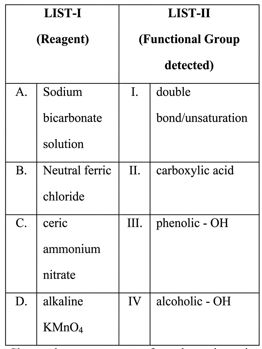
Choose the correct answer from the options given below :
We recall the characteristic qualitative tests used in practical organic chemistry:
Reagent A : $$NaHCO_3$$ (sodium bicarbonate solution)
• Carboxylic acids react with $$NaHCO_3$$ producing brisk effervescence of $$CO_2$$.
• Hence this test identifies the $$-COOH$$ group.
⇒ Functional group detected = II (carboxylic acid).
Reagent B : neutral $$FeCl_3$$ solution
• Phenols form coloured (purple, green, blue) complexes with neutral $$Fe^{3+}$$ ions.
• Therefore it is used to confirm phenolic $$-OH$$ groups.
⇒ Functional group detected = III (phenolic -OH).
Reagent C : ceric ammonium nitrate, $$ (NH_4)_2[Ce(NO_3)_6] $$
• Alcohols give a wine-red or magenta colour with this reagent due to formation of a Ce(IV) complex.
• Thus it detects alcoholic $$-OH$$ groups.
⇒ Functional group detected = IV (alcoholic -OH).
Reagent D : alkaline $$KMnO_4$$ (Baeyer’s test)
• Alkaline $$KMnO_4$$ is decolourised by compounds containing $$C=C$$ or $$C \equiv C$$ bonds (unsaturation).
• Hence it is the standard test for double or triple bonds.
⇒ Functional group detected = I (double bond / unsaturation).
Collecting the matches:
• A → II
• B → III
• C → IV
• D → I
This corresponds to Option A: A-II, B-III, C-IV, D-I.
Therefore, the correct answer is Option A.
Was this solution helpful?
Click on the Email ☝️ to Watch the Video Solution
Create a FREE account and get:
_1.webp)

Educational materials for JEE preparation

Ask our AI anything

AI can make mistakes. Please verify important information.
AI can make mistakes. Please verify important information.
