
Join Our JEE Preparation Group
Prep with like-minded aspirants; Get access to free daily tests and study material.
Sign in
Please select an account to continue using cracku.in
↓ →
Join Our JEE Preparation Group
Prep with like-minded aspirants; Get access to free daily tests and study material.
Match the LIST-I with LIST-II
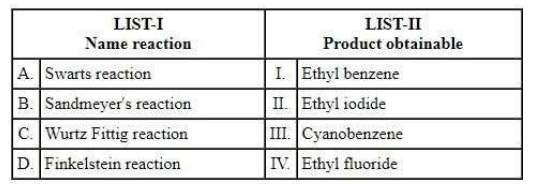
Choose the correct answer from the options given below:
The reactivity pattern of halogen-containing organic compounds toward common nucleophilic substitution reactions is governed by two main factors:
1. Stability of the carbocation (for $$S_N1$$).
2. Ease of backside attack (for $$S_N2$$) which is helped by low steric hindrance and by resonance-assisted transition states.
Keeping these points in mind, let us analyse each compound in LIST-I and locate its proper description in LIST-II.
Case A:A species in which the leaving chloride is directly attached to an sp²-carbon of a C=C double bond (a vinylic chloride). The C-Cl bond is strongly $$sp^2$$ hybridised and possesses partial double-bond character; therefore the bond is extremely resistant to both $$S_N1$$ (carbocation would be vinylic and unstable) and $$S_N2$$ (back-side attack impossible because of the planar, rigid $$\pi$$ system). Hence this compound is the one that “does not undergo ordinary nucleophilic substitution”. That description corresponds to Roman numeral IV.
So, $$A \rightarrow IV$$.
Case B:An allylic chloride has its leaving group on a carbon that is next to a C=C double bond. In an $$S_N1$$ pathway it can generate a resonance-stabilised allylic carbocation, while in an $$S_N2$$ pathway the nucleophile can attack the antibonding $$\sigma^*_{C-Cl}$$ orbital that is conjugated with the $$\pi$$ bond, lowering the transition-state energy. Thus an allyl chloride is reactive by both $$S_N1$$ and $$S_N2$$ mechanisms, making it “reactive by either route”. This matches Roman numeral III.
So, $$B \rightarrow III$$.
Case C:The compound whose description in LIST-II reads “undergoes $$S_N1$$ fairly readily but not $$S_N2$$” must be a secondary (or tertiary) alkyl chloride in which steric hindrance blocks back-side attack, yet the carbocation is sufficiently stabilised for ionisation. Among the given structures, the one that fits this wording is the secondary alkyl chloride (e.g. isopropyl chloride). Therefore Case C must link with Roman numeral I.
So, $$C \rightarrow I$$.
Case D:A benzyl chloride gives a benzyl carbocation that is strongly stabilised by resonance with the aromatic ring; at the same time, the benzylic carbon is only primary, so steric hindrance is minimal. Hence a benzyl chloride is the “most reactive in both $$S_N1$$ and $$S_N2$$” category, listed as Roman numeral II.
So, $$D \rightarrow II$$.
Collecting all four links we have:
A-IV, B-III, C-I, D-II
The option that states this combination is Option D.
Final Answer: Option D which is: A-IV, B-III, C-I, D-II.
Was this solution helpful?
Create a FREE account and get:
_1.webp)

Educational materials for JEE preparation

Ask our AI anything

AI can make mistakes. Please verify important information.
AI can make mistakes. Please verify important information.
