
Join Our JEE Preparation Group
Prep with like-minded aspirants; Get access to free daily tests and study material.
Sign in
Please select an account to continue using cracku.in
↓ →
Join Our JEE Preparation Group
Prep with like-minded aspirants; Get access to free daily tests and study material.
Given below are two statements:
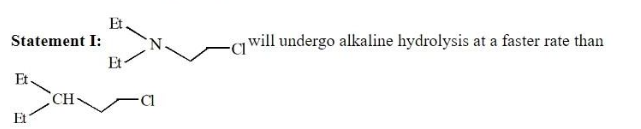

involving lone pair of electrons on nitrogen. In the light of the above statements, choose the most appropriate answer from the options given below
The correctness of the two statements has to be checked only on the basis of the availability of the lone-pair on the nitrogen atom. Whenever that lone pair can participate in resonance (delocalisation) its availability for donation to an external proton decreases, hence basicity decreases. Conversely, if the lone pair remains localised on nitrogen it is freely available and the compound is more basic.
Case 1: Lone pair involved in resonance with a carbonyl group (amide).
In an amide, the nitrogen is directly attached to the $$C=O$$ group. The lone pair on nitrogen overlaps with the vacant $$\pi^{*}$$ orbital of the carbonyl carbon giving the resonating structures
$$R-C(=O)-NH_2 \rightleftharpoons R-C(O^{-})=NH_2^{+}$$
Because of this conjugation, the lone pair is not freely available for protonation, so amides are very weak bases. Statement I—which attributes the low basicity of amides to delocalisation of the lone pair—is therefore correct.
Case 2: Lone pair involved in resonance with an aromatic ring (aniline).
In aniline, the nitrogen lone pair can conjugate with the benzene ring to give structures such as
$$\mathrm{Ph-NH_2 \;\rightleftharpoons\; Ph^{-}=NH_2^{+}}$$
Again the lone pair is partially withdrawn from nitrogen, so aniline is less basic than aliphatic amines. Statement II—which explains reduced basicity of aniline (or its acylated derivative) through similar resonance—is also correct.
Since both statements correctly explain the lowered basicity by the same underlying factor—resonance delocalisation of the nitrogen lone pair—both are true.
Option C which is: Both Statement I and Statement II are correct
Was this solution helpful?
Create a FREE account and get:
_1.webp)

Educational materials for JEE preparation

Ask our AI anything

AI can make mistakes. Please verify important information.
AI can make mistakes. Please verify important information.
