
Join Our JEE Preparation Group
Prep with like-minded aspirants; Get access to free daily tests and study material.
Sign in
Please select an account to continue using cracku.in
↓ →
Join Our JEE Preparation Group
Prep with like-minded aspirants; Get access to free daily tests and study material.
The cell, $$Zn|Zn^{2+}(1M)||Cu^{2+}(1M)|Cu$$ ($$E^0_{cell} = 1.10$$ V), was allowed to be completely discharged at 298 K. The relative concentration of $$Zn^{2+}$$ to $$Cu^{2+}$$ $$\left[\frac{[Zn^{2+}]}{[Cu^{2+}]}\right]$$ is
The galvanic cell is
$$Zn|Zn^{2+}(1\,\text{M})\;||\;Cu^{2+}(1\,\text{M})|Cu$$
Its standard cell reaction is
$$Zn + Cu^{2+} \rightarrow Zn^{2+} + Cu$$
Number of electrons transferred, $$n = 2$$.
For the reaction $${\text{Red}} \rightarrow {\text{Ox}}$$ the Nernst equation at $$298\;\text{K}$$ is
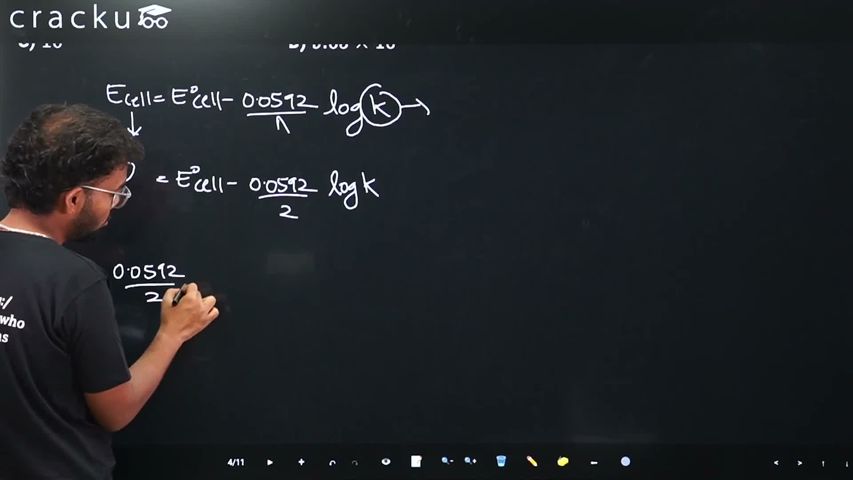
$$E_{\text{cell}} = E^{0}_{\text{cell}} - \frac{0.0592}{n}\log Q$$
where $$Q$$ is the reaction quotient.
Here
$$Q = \frac{[Zn^{2+}]}{[Cu^{2+}]}$$
because activities of the solids $$Zn$$ and $$Cu$$ are 1.
The cell is said to be “completely discharged”, which means it has reached equilibrium, so $$E_{\text{cell}} = 0$$. Setting $$E_{\text{cell}} = 0$$ gives
$$0 = E^{0}_{\text{cell}} - \frac{0.0592}{n}\log K$$
$$\Rightarrow \log K = \frac{n\,E^{0}_{\text{cell}}}{0.0592}$$
where $$K$$ is the equilibrium constant of the reaction.
Substituting $$n = 2$$ and $$E^{0}_{\text{cell}} = 1.10\;\text{V}$$:
$$\log K = \frac{2 \times 1.10}{0.0592} = \frac{2.20}{0.0592}\approx 37.3$$
Therefore
$$K = 10^{37.3}$$
At equilibrium $$K = \dfrac{[Zn^{2+}]}{[Cu^{2+}]}$$, so
$$\frac{[Zn^{2+}]}{[Cu^{2+}]} = 10^{37.3}$$
Hence the required ratio is Option C which is: $$10^{37.3}$$.
Was this solution helpful?
Click on the Email ☝️ to Watch the Video Solution
Create a FREE account and get:
_1.webp)

Educational materials for JEE preparation

Ask our AI anything

AI can make mistakes. Please verify important information.
AI can make mistakes. Please verify important information.
