Join WhatsApp Icon JEE WhatsApp Group
Question 66

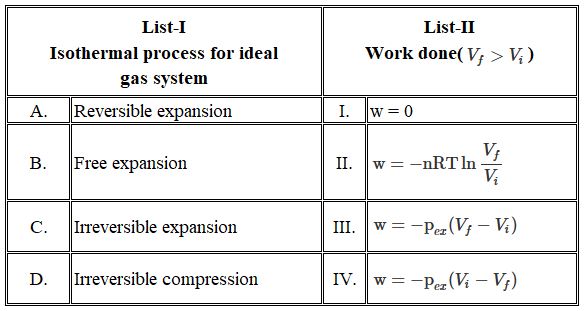
Match the LIST-I with LIST-II

Screenshot_59


Choose the correct answer from the options given befow:

1. Reversible Expansion (A $$\rightarrow$$ II)

In a reversible process, the expansion happens infinitely slowly such that the external pressure ($$P_{ext}$$) is always nearly equal to the internal pressure ($$P_{int}$$). To find the work, we integrate the pressure over the volume change.

  • Formula: $$w = -nRT \ln \frac{V_f}{V_i}$$
  • Key Detail: Because the temperature is constant (isothermal), the work is defined by the logarithmic ratio of final to initial volume.

2. Free Expansion (B $$\rightarrow$$ I)

Free expansion occurs when a gas expands into a vacuum. By definition, a vacuum exerts zero external pressure ($$P_{ext} = 0$$).

  • Formula: $$w = 0$$
  • Key Detail: Since there is no opposing force to push against, the gas does no work, regardless of how much the volume increases.

3. Irreversible Expansion (C $$\rightarrow$$ III)

This occurs when a gas expands against a constant external pressure that is significantly lower than the initial internal pressure (like suddenly removing a weight from a piston).

  • Formula: $$w = -P_{ex}(V_f - V_i)$$
  • Key Detail: The work is simply the product of the constant external pressure and the change in volume ($$\Delta V$$). Since $$V_f > V_i$$, the work value is negative, indicating energy is leaving the system.

4. Irreversible Compression (D $$\rightarrow$$ IV)

Compression is the opposite of expansion; an external force is used to decrease the volume of the gas.

  • Formula: $$w = -P_{ex}(V_i - V_f)$$
  • Key Detail: In compression, $$V_f < V_i$$. This formula is mathematically structured to ensure that work done on the system results in a positive value, reflecting an increase in the system's energy.

Get AI Help

Create a FREE account and get:

  • Free JEE Mains Previous Papers PDF
  • Take JEE Mains paper tests

JEE Quant Questions | JEE Quantitative Ability

JEE DILR Questions | LRDI Questions For JEE

JEE Verbal Ability Questions | VARC Questions For JEE

Free JEE Topicwise Questions

JEE Rotational MotionJEE Units & MeasurementsJEE Atomic StructureJEE GravitationJEE Periodic Table & PeriodicityJEE StatisticsJEE Inverse Trigonometric FunctionsJEE Magnetism & Magnetic MaterialsJEE Sequences & SeriesJEE MatricesJEE Alternating CurrentsJEE Carboxylic AcidsJEE Permutations & CombinationsJEE Work, Energy & PowerJEE Electromagnetic InductionJEE Electronic DevicesJEE d and f-Block ElementsJEE Chemical KineticsJEE Heat TransferJEE Three Dimensional GeometryJEE Magnetic Effects of CurrentJEE Hydrocarbons - AromaticJEE Electromagnetic WavesJEE Aldehydes & KetonesJEE Hydrocarbons - AlkanesJEE Applications of DerivativesJEE EquilibriumJEE Indefinite IntegrationJEE Chemical ThermodynamicsJEE ElectrochemistryJEE ProbabilityJEE BiomoleculesJEE Continuity & DifferentiabilityJEE Kinetic Theory of GasesJEE Vector AlgebraJEE Hydrocarbons - AlkynesJEE Differential EquationsJEE Current & ResistanceJEE Straight LinesJEE WavesJEE Redox ReactionsJEE Hydrocarbons - AlkenesJEE DeterminantsJEE SolutionsJEE Ray OpticsJEE Dual Nature of Matter & RadiationJEE Chemical Bonding & Molecular StructureJEE Complex NumbersJEE Sets, Relations & FunctionsJEE Electric Charges & FieldsJEE Laws of MotionJEE Fluid MechanicsJEE Basic Concepts in ChemistryJEE Trigonometric FunctionsJEE LimitsJEE Laws of ThermodynamicsJEE Kinematics - 2D MotionJEE p-Block Elements (Groups 13-18)JEE Simple Harmonic MotionJEE Electric Potential & CapacitanceJEE Coordination CompoundsJEE JEE 2D GeometryJEE CirclesJEE Definite IntegrationJEE EMF & Circuit AnalysisJEE Surface TensionJEE Atoms & NucleiJEE Laboratory Experiments - XIJEE Number SystemJEE Basic Principles of Organic ChemistryJEE Wave OpticsJEE Quadratic EquationsJEE Alcohols, Phenols & EthersJEE Organic Compounds with HalogensJEE DifferentiationJEE Conic SectionsJEE Nitrogen-Containing CompoundsJEE ElasticityJEE Practical Organic ChemistryJEE Kinematics - 1D MotionJEE Purification & CharacterisationJEE Binomial Theorem
Ask AI