
Join Our JEE Preparation Group
Prep with like-minded aspirants; Get access to free daily tests and study material.
Sign in
Please select an account to continue using cracku.in
↓ →
Join Our JEE Preparation Group
Prep with like-minded aspirants; Get access to free daily tests and study material.
Given below are two statements:
$$\textbf{Statement I :}$$ The condensation reaction between $$\text{CH}_3-\text{CH}=\text{O}$$ and
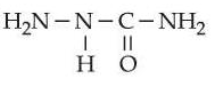
under optimum pH will produce
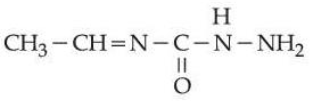
$$\textbf{Statement II :}$$ The molecule
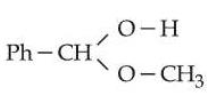
will generate $$\text{Ph}-\text{CH}=\text{O}$$ in the presence of dilute acid.
In the light of the above statements, choose the correct answer from the options given below:
Statement I - Self-condensation of acetaldehyde
Acetaldehyde is represented as $$CH_3CHO$$ (the abbreviated notation $$CH_3{-}CH{=}O$$). When the pH of the medium is adjusted to a mild value of about 7-8 (weakly basic), an enolate ion can be generated without causing extensive dehydration. Two molecules of the aldehyde then undergo the aldol reaction:
$$2\,CH_3CHO \;\xrightarrow[\text{pH }7\text{-}8]{OH^-}\; CH_3CH(OH)CH_2CHO$$
The product is 3-hydroxybutanal, the normal “aldol’’ obtained before any loss of water. Thus the condensation described in Statement I is correctly stated, so Statement I is true.
Statement II - Acidic hydrolysis of an acetal
Acetals (dialkoxy derivatives) revert to the parent carbonyl compound in the presence of dilute mineral acid. For benzaldehyde dimethyl acetal the reaction is
$$PhCH(OMe)_2 + H_2O \;\xrightarrow{\text{dil.\ }H^+}\; PhCHO + 2\,MeOH$$
Hence the molecule named in Statement II indeed generates $$PhCHO$$ (benzaldehyde) on treatment with dilute acid, so Statement II is also true.
Since both statements are correct, the option that matches this situation is:
Option A which is: Both statements are true
Was this solution helpful?
Create a FREE account and get:
_1.webp)

Educational materials for JEE preparation

Ask our AI anything

AI can make mistakes. Please verify important information.
AI can make mistakes. Please verify important information.
