
Join Our JEE Preparation Group
Prep with like-minded aspirants; Get access to free daily tests and study material.
Sign in
Please select an account to continue using cracku.in
↓ →
Join Our JEE Preparation Group
Prep with like-minded aspirants; Get access to free daily tests and study material.
Given below are two statements:
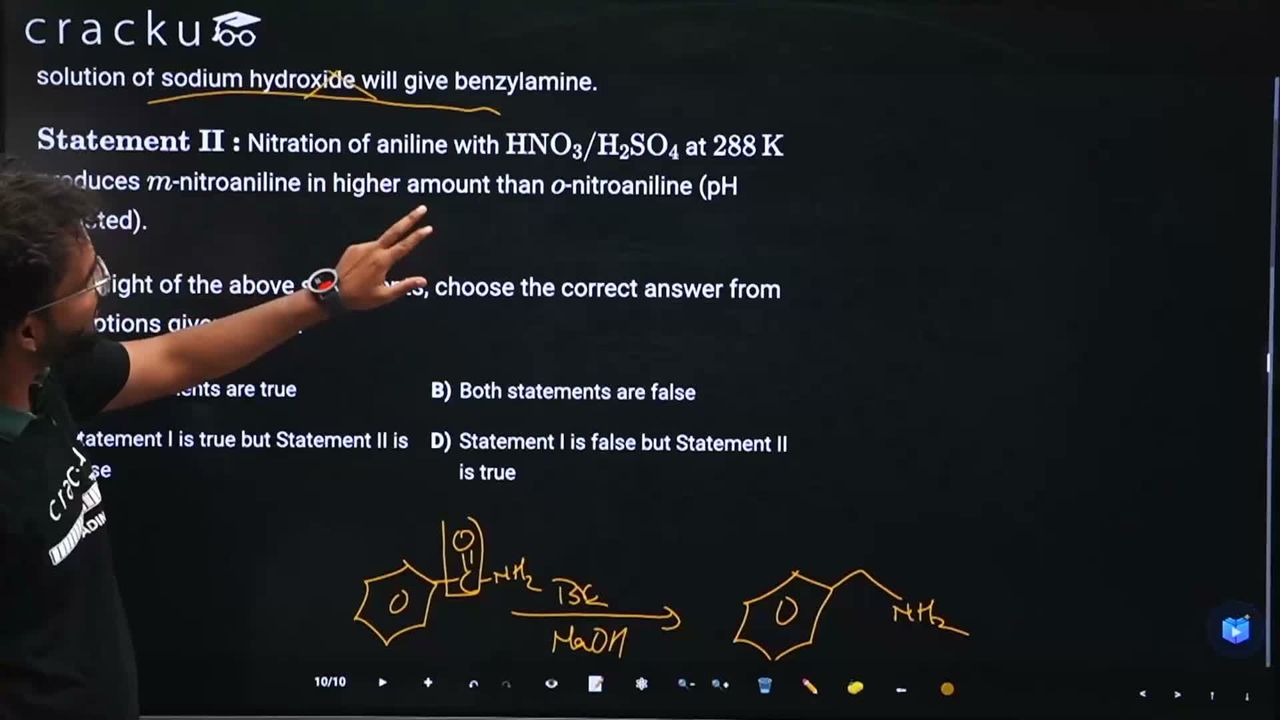
$$\textbf{Statement I :}$$ Heating benzamide with bromine in an ethanolic solution of sodium hydroxide will give benzylamine.
$$\textbf{Statement II :}$$ Nitration of aniline with $$\text{HNO}_3/\text{H}_2\text{SO}_4$$ at $$288\,\text{K}$$ produces $$m$$-nitroaniline in higher amount than $$o$$-nitroaniline (pH adjusted).
In the light of the above statements, choose the correct answer from the options given below:
In the Hofmann bromamide degradation reaction, a primary amide is converted into a primary amine containing one carbon atom less.
For benzamide,
$$C_6H_5CONH_2 \xrightarrow{Br_2/NaOH} C_6H_5NH_2.$$
Thus, benzamide produces aniline and not benzylamine ((C_6H_5CH_2NH_2)). Therefore, Statement I is false.
During the nitration of aniline using the nitrating mixture ((HNO_3/H_2SO_4)), the amino group is protonated in the strongly acidic medium to form the anilinium ion ((-NH_3^+)). The anilinium ion is electron-withdrawing and acts as a meta-directing group.
As a result, nitration under these conditions produces (m)-nitroaniline in a higher proportion than (o)-nitroaniline.
Therefore, Statement II is true.
Hence, the correct answer is Statement I is false but Statement II is true.
Was this solution helpful?
Click on the Email ☝️ to Watch the Video Solution
Create a FREE account and get:
_1.webp)

Educational materials for JEE preparation

Ask our AI anything

AI can make mistakes. Please verify important information.
AI can make mistakes. Please verify important information.
