
Join Our JEE Preparation Group
Prep with like-minded aspirants; Get access to free daily tests and study material.
Sign in
Please select an account to continue using cracku.in
↓ →
Join Our JEE Preparation Group
Prep with like-minded aspirants; Get access to free daily tests and study material.
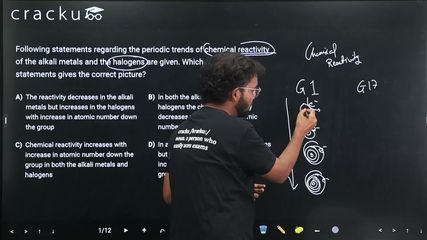
Following statements regarding the periodic trends of chemical reactivity of the alkali metals and the halogens are given. Which of these statements gives the correct picture?
In any group of the periodic table, the deciding factor for chemical reactivity is the ease with which the characteristic electronic change of that group can take place.
Alkali metals (Group 1) react by losing one electron to form $$M^{+}$$ ions, whereas halogens (Group 17) react by gaining one electron to form $$X^{-}$$ ions.
Alkali metals (Group 1):
1. Atomic radius increases down the group, so the outermost electron is farther from the nucleus.
2. Shielding effect increases, nuclear attraction for the valence electron decreases.
3. First ionisation enthalpy therefore decreases down the group.
Because it becomes progressively easier for the atom to lose its lone valence electron, the tendency to undergo chemical reactions (e.g., forming hydroxides, oxides, halides, etc.) increases. Hence the reactivity of alkali metals increases from Li → Cs.
Halogens (Group 17):
1. Atomic radius also increases down the group, placing the valence shell farther from the nucleus.
2. Shielding effect rises, reducing the effective nuclear pull on an incoming electron.
3. Electron affinity (electron-gain enthalpy) becomes less negative; electronegativity falls down the group.
Since a halogen’s reactivity depends on its ability to accept an additional electron to achieve the noble-gas configuration, the decreasing electron affinity makes this process less favourable. Therefore the reactivity of halogens decreases from F → I.
Combining the two trends: reactivity increases down Group 1 but decreases down Group 17.
Hence, the statement that matches the actual periodic trends is:
Option D which is: In alkali metals the reactivity increases but in the halogens it decreases with increase in atomic number down the group.
Was this solution helpful?
Click on the Email ☝️ to Watch the Video Solution
Create a FREE account and get:
_1.webp)

Educational materials for JEE preparation

Ask our AI anything

AI can make mistakes. Please verify important information.
AI can make mistakes. Please verify important information.
