
Join Our JEE Preparation Group
Prep with like-minded aspirants; Get access to free daily tests and study material.
Sign in
Please select an account to continue using cracku.in
↓ →
Join Our JEE Preparation Group
Prep with like-minded aspirants; Get access to free daily tests and study material.
The sum of the series $$1^2 + 2 \cdot 2^2 + 3^2 + 2 \cdot 4^2 + 5^2 + 2 \cdot 6^2 + \ldots + 2(2m)^2$$ is
The series can be rewritten by grouping one odd square and the subsequent doubled even square:
$$1^2 + 2\cdot 2^2 + 3^2 + 2\cdot 4^2 + 5^2 + 2\cdot 6^2 + \dots + 2(2m)^2$$
$$= \bigl(1^2 + 2\cdot 2^2\bigr) + \bigl(3^2 + 2\cdot 4^2\bigr) + \dots + \bigl((2m-1)^2 + 2\cdot (2m)^2\bigr).$$
Hence there are exactly $$m$$ pairs, each pair containing one odd square $$(2k-1)^2$$ and one doubled even square $$2(2k)^2$$, where $$k=1,2,\dots ,m$$.
Let $$S$$ be the required sum.
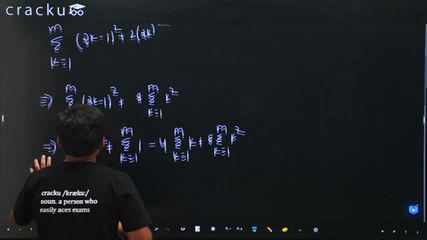
$$\displaystyle S = \sum_{k=1}^{m}\Bigl[(2k-1)^2 + 2(2k)^2\Bigr].$$
Case 1: Sum of the odd squares
$$\displaystyle S_1 = \sum_{k=1}^{m}(2k-1)^2.$$
Expand the square:
$$(2k-1)^2 = 4k^2 - 4k + 1.$$
Therefore
$$S_1 = 4\sum_{k=1}^{m}k^2 \;-\; 4\sum_{k=1}^{m}k \;+\; \sum_{k=1}^{m}1.$$
Using the standard formulae
$$\sum_{k=1}^{m}k = \frac{m(m+1)}{2},$$
$$\sum_{k=1}^{m}k^2 = \frac{m(m+1)(2m+1)}{6},$$
we get
$$S_1 = 4\cdot\frac{m(m+1)(2m+1)}{6} \;-\; 4\cdot\frac{m(m+1)}{2} \;+\; m$$
$$\;\;= \frac{2}{3}m(m+1)(2m+1) \;-\; 2m(m+1) \;+\; m.$$
Case 2: Sum of the doubled even squares
$$\displaystyle S_2 = \sum_{k=1}^{m} 2(2k)^2 = 2\cdot 4\sum_{k=1}^{m}k^2 = 8\sum_{k=1}^{m}k^2.$$
Using the same $$\sum k^2$$ formula:
$$S_2 = 8\cdot \frac{m(m+1)(2m+1)}{6} = \frac{4}{3}m(m+1)(2m+1).$$
Total sum
$$S = S_1 + S_2$$
$$\;\;= \left[\frac{2}{3}m(m+1)(2m+1) - 2m(m+1) + m\right] + \frac{4}{3}m(m+1)(2m+1)$$
Combine the first two rational terms:
$$\frac{2}{3} + \frac{4}{3} = 2,$$
so
$$S = 2m(m+1)(2m+1) - 2m(m+1) + m.$$
Factor $$2m$$ from the first two terms:
$$S = 2m\bigl[(m+1)(2m+1) - (m+1)\bigr] + m$$
$$\;\;= 2m(m+1)\bigl[(2m+1)-1\bigr] + m$$
$$\;\;= 2m(m+1)(2m) + m$$
$$\;\;= 4m^2(m+1) + m.$$
Finally, factor $$m$$ out:
$$S = m\bigl[4m(m+1) + 1\bigr] = m\bigl[4m^2 + 4m + 1\bigr] = m(2m+1)^2.$$
Therefore, the required sum equals $$m(2m+1)^2$$.
Option A which is: $$m(2m+1)^2$$
Was this solution helpful?
Click on the Email ☝️ to Watch the Video Solution
Create a FREE account and get:
_1.webp)

Educational materials for JEE preparation

Ask our AI anything

AI can make mistakes. Please verify important information.
AI can make mistakes. Please verify important information.


