Join Our JEE Preparation Group
Prep with like-minded aspirants; Get access to free daily tests and study material.
Sign in
Please select an account to continue using cracku.in
↓ →
Join Our JEE Preparation Group
Prep with like-minded aspirants; Get access to free daily tests and study material.
Solvolysis of an alkyl (or aryl-alkyl) chloride in a polar protic solvent generally follows the $$S_N1$$ pathway whenever the intermediate carbocation is reasonably stable. Hence the relative rate is dictated almost completely by the relative stability of the carbocation that forms after $$Cl^-$$ leaves.
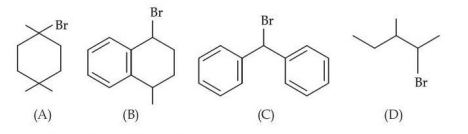
Case D: Compound (D) is a primary alkyl chloride. Loss of $$Cl^-$$ would generate a primary carbocation, which is highly unstable because it lacks both resonance and extensive hyperconjugation. Therefore (D) undergoes solvolysis extremely slowly.
Case A: Compound (A) is a tertiary alkyl chloride (for example, $$\;(CH_3)_3C-Cl$$). The resulting tertiary carbocation is stabilised by three electron-releasing alkyl groups through the inductive effect and hyperconjugation. Thus (A) reacts faster than the primary chloride (D) but still lacks any resonance stabilisation.
Case B: Compound (B) is a benzylic chloride. When $$Cl^-$$ departs, the benzylic carbocation is generated; it is resonance-stabilised by the adjoining aromatic ring, spreading the positive charge over several carbon atoms. A benzylic (even though formally “primary”) carbocation is considerably more stable than a purely aliphatic tertiary carbocation, so (B) solvolyses faster than (A).
Case C: Compound (C) is an even more highly stabilised benzylic system (e.g. diphenylmethyl chloride or a benzylic chloride bearing an additional electron-donating substituent). Its carbocation is delocalised over two phenyl rings or over an ether-substituted ring, giving it the maximum resonance stabilisation among the four substrates. Consequently, (C) shows the highest rate of solvolysis.
Summarising the stability (and therefore the rate):
primary aliphatic < tertiary aliphatic < benzylic < highly resonance-stabilised benzylic.
Hence the ascending order of the relative rate of solvolysis is
$$ (D) \; \lt \; (A) \; \lt \; (B) \; \lt \; (C) $$
Option B which is: (D) < (A) < (B) < (C)
Was this solution helpful?
Create a FREE account and get:
_1.webp)

Educational materials for JEE preparation

Ask our AI anything

AI can make mistakes. Please verify important information.
AI can make mistakes. Please verify important information.