
Join Our JEE Preparation Group
Prep with like-minded aspirants; Get access to free daily tests and study material.
Sign in
Please select an account to continue using cracku.in
↓ →
Join Our JEE Preparation Group
Prep with like-minded aspirants; Get access to free daily tests and study material.
Given below are two statements:
Statement I: Methane can be prepared by decarboxylation of sodium ethanoate, Kolbe's electrolysis of sodium acetate and reaction of CH$$_3$$MgBr with water.
Statement II: Methane cannot be prepared from unsaturated hydrocarbons and by Wurtz reaction.
In the light of the above statements, choose the correct answer from the options given below:
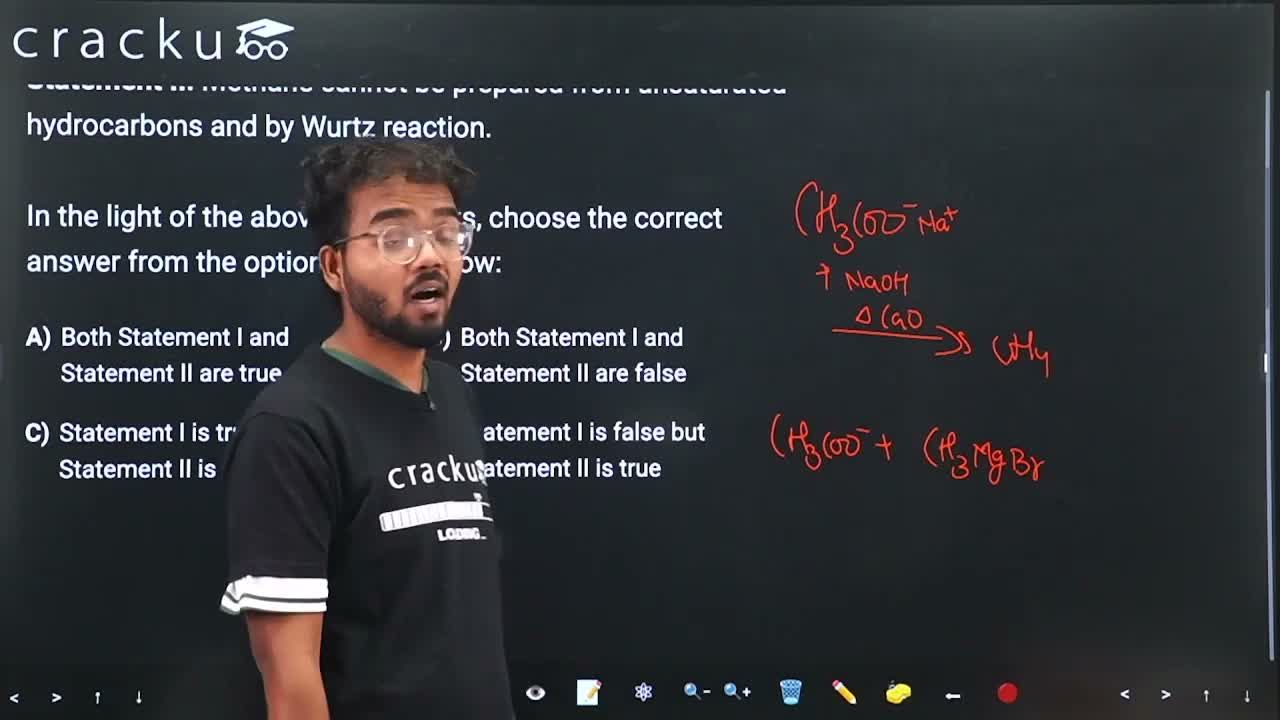
In Statement I, methane can be prepared by decarboxylation of sodium ethanoate with soda lime:
$$CH_3COONa+NaOH\xrightarrow{\Delta,\ CaO}CH_4+Na_2CO_3.$$
Methane is also obtained by the hydrolysis of methyl magnesium bromide:
$$CH_3MgBr+H_2O\rightarrow CH_4+Mg(OH)Br.$$
However, Kolbe's electrolysis of sodium acetate does not produce methane. Instead, it gives ethane by coupling of methyl radicals:
$$2CH_3COO^-\xrightarrow{\text{electrolysis}}C_2H_6+2CO_2.$$
Therefore, Statement I is false.
In Statement II, methane cannot be prepared by hydrogenation of unsaturated hydrocarbons because hydrogenation only converts alkenes or alkynes into higher alkanes and cannot reduce the carbon count to one. Methane also cannot be prepared by the Wurtz reaction since Wurtz coupling always combines two alkyl halides to form a higher alkane containing at least two carbon atoms.
Therefore, Statement II is true.
Hence, Statement I is false, Statement II is true, and the correct answer is Option D.
Was this solution helpful?
Click on the Email ☝️ to Watch the Video Solution
Create a FREE account and get:
_1.webp)

Educational materials for JEE preparation

Ask our AI anything

AI can make mistakes. Please verify important information.
AI can make mistakes. Please verify important information.


