
Join Our JEE Preparation Group
Prep with like-minded aspirants; Get access to free daily tests and study material.
Sign in
Please select an account to continue using cracku.in
↓ →
Join Our JEE Preparation Group
Prep with like-minded aspirants; Get access to free daily tests and study material.
Given below are two statements:
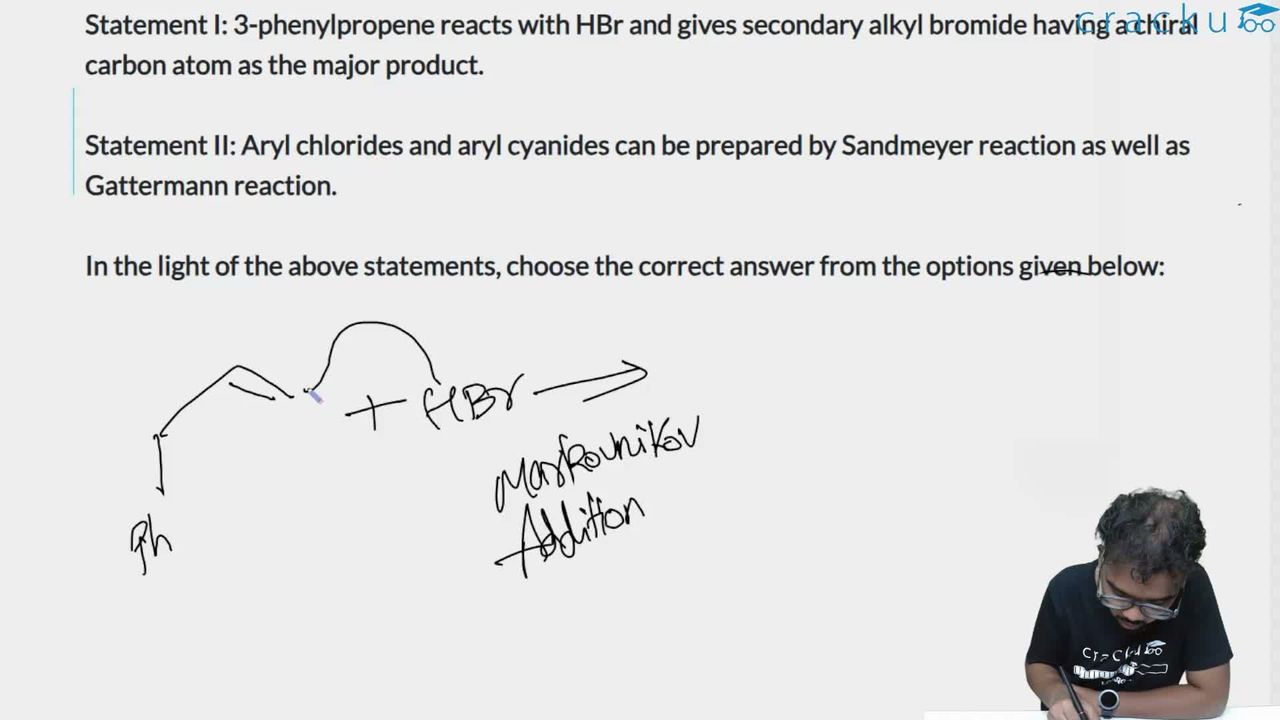
Statement I: 3-phenylpropene reacts with HBr and gives secondary alkyl bromide having a chiral carbon atom as the major product.
Statement II: Aryl chlorides and aryl cyanides can be prepared by Sandmeyer reaction as well as Gattermann reaction.
In the light of the above statements, choose the correct answer from the options given below:
For Statement I, 3-phenylpropene ((C_6H_5CH_2CH=CH_2)) undergoes electrophilic addition with (HBr) according to Markovnikov’s rule. Protonation of the double bond generates a resonance-stabilized benzylic carbocation, which is then attacked by (Br^-) to form 1-phenyl-1-bromopropane.
The product formed is
$$C_6H_5CH(Br)CH_2CH_3.$$
The carbon bearing the bromine atom is attached to four different groups ((Br,\ H,\ CH_2CH_3,\ C_6H_5)), making it a chiral carbon. Hence, Statement I is true.
For Statement II, the Sandmeyer reaction is used to prepare aryl chlorides and aryl cyanides from diazonium salts using cuprous salts. Although the Gattermann reaction can be employed for the preparation of aryl chlorides and aryl bromides, it is not the standard method for the preparation of aryl cyanides.
Therefore, Statement II is false.
Hence, Statement I is true, Statement II is false, and the correct answer is Option C.
Was this solution helpful?
Click on the Email ☝️ to Watch the Video Solution
Create a FREE account and get:
_1.webp)

Educational materials for JEE preparation

Ask our AI anything

AI can make mistakes. Please verify important information.
AI can make mistakes. Please verify important information.


