
Join Our JEE Preparation Group
Prep with like-minded aspirants; Get access to free daily tests and study material.
Sign in
Please select an account to continue using cracku.in
↓ →
Join Our JEE Preparation Group
Prep with like-minded aspirants; Get access to free daily tests and study material.
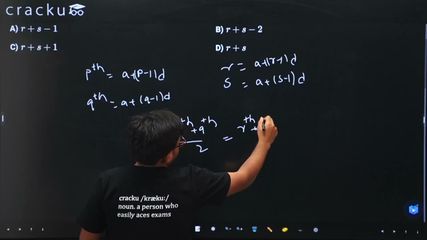
If the A.M. between $$p^{th}$$ and $$q^{th}$$ terms of an A.P. is equal to the A.M. between $$r^{th}$$ and $$s^{th}$$ terms of the same A.P., then $$p + q$$ is equal to
Let the arithmetic progression (A.P.) have first term $$a$$ and common difference $$d$$.
The $$n^{\text{th}}$$ term of an A.P. is $$T_n = a + (n-1)d$$.
Therefore,
$$T_p = a + (p-1)d,$$
$$T_q = a + (q-1)d,$$
$$T_r = a + (r-1)d,$$
$$T_s = a + (s-1)d.$$
The arithmetic mean (A.M.) between the $$p^{\text{th}}$$ and $$q^{\text{th}}$$ terms is
$$\text{A.M.}_{pq} = \frac{T_p + T_q}{2}.$$
The A.M. between the $$r^{\text{th}}$$ and $$s^{\text{th}}$$ terms is
$$\text{A.M.}_{rs} = \frac{T_r + T_s}{2}.$$
Given $$\text{A.M.}_{pq} = \text{A.M.}_{rs},$$ we have
$$\frac{T_p + T_q}{2} = \frac{T_r + T_s}{2}.$$
Multiply by 2 to clear the denominators:
$$T_p + T_q = T_r + T_s.$$
Substitute the expressions of the terms:
$$\bigl[a + (p-1)d\bigr] + \bigl[a + (q-1)d\bigr] = \bigl[a + (r-1)d\bigr] + \bigl[a + (s-1)d\bigr].$$
Simplify both sides:
$$2a + (p + q - 2)d = 2a + (r + s - 2)d.$$
Subtract $$2a$$ from both sides and, provided $$d \neq 0,$$ divide by $$d$$:
$$p + q - 2 = r + s - 2 \;\;\Longrightarrow\;\; p + q = r + s.$$
(If $$d = 0,$$ every term of the A.P. is equal, and the equality still holds for all valid indices, so the same result follows.)
Hence $$p + q = r + s$$.
Option D which is: $$r + s$$
Was this solution helpful?
Click on the Email ☝️ to Watch the Video Solution
Create a FREE account and get:
_1.webp)

Educational materials for JEE preparation

Ask our AI anything

AI can make mistakes. Please verify important information.
AI can make mistakes. Please verify important information.


