
Join Our JEE Preparation Group
Prep with like-minded aspirants; Get access to free daily tests and study material.
Sign in
Please select an account to continue using cracku.in
↓ →
Join Our JEE Preparation Group
Prep with like-minded aspirants; Get access to free daily tests and study material.
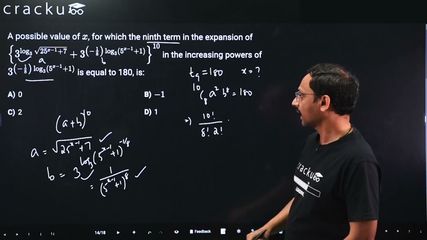
A possible value of $$x$$, for which the ninth term in the expansion of $$\left\{3^{\log_3 \sqrt{25^{x-1}+7}} + 3^{\left(-\frac{1}{8}\right)\log_3(5^{x-1}+1)}\right\}^{10}$$ in the increasing powers of $$3^{\left(-\frac{1}{8}\right)\log_3(5^{x-1}+1)}$$ is equal to 180, is:
1. Simplify the Terms Using Logarithmic Properties
Using the fundamental property of logarithms where $$b^{\log_b y} = y$$, we can simplify both terms within the given binomial expression:
For the first term:
$$a = 3^{\log_3 \sqrt{25^{x-1}+7}} = \sqrt{25^{x-1}+7}$$
For the second term:
$$b = 3^{\left(-\frac{1}{8}\right)\log_3(5^{x-1}+1)} = 3^{\log_3 (5^{x-1}+1)^{-\frac{1}{8}}} = (5^{x-1}+1)^{-\frac{1}{8}}$$
Thus, the given expression simplifies directly to the standard binomial form:
$$(a + b)^{10} = \left(\sqrt{25^{x-1}+7} + (5^{x-1}+1)^{-\frac{1}{8}}\right)^{10}$$
2. Write the Ninth Term Formula
The general term $$T_{r+1}$$ in a binomial expansion of $$(a+b)^n$$ is defined by:
$$T_{r+1} = \binom{n}{r} a^{n-r} b^r$$
For the ninth term ($$T_9$$), we substitute $$r = 8$$ and $$n = 10$$ into the expression:
$$T_9 = \binom{10}{8} a^{10-8} b^8$$
$$T_9 = \binom{10}{8} a^2 b^8$$
3. Substitute the Simplified Terms
Substitute the expressions for $$a$$ and $$b$$ into the ninth term formula:
$$T_9 = \binom{10}{8} \left(\sqrt{25^{x-1}+7}\right)^2 \left((5^{x-1}+1)^{-\frac{1}{8}}\right)^8$$
Now, evaluate each part step-by-step:
$$\binom{10}{8} = \frac{10 \times 9}{2 \times 1} = 45$$
$$\left(\sqrt{25^{x-1}+7}\right)^2 = 25^{x-1}+7$$
$$\left((5^{x-1}+1)^{-\frac{1}{8}}\right)^8 = (5^{x-1}+1)^{-1} = \frac{1}{5^{x-1}+1}$$
Combine these components together:
$$T_9 = 45 \cdot \frac{25^{x-1}+7}{5^{x-1}+1}$$
4. Solve the Algebraic Equation
We are given that the ninth term is equal to $$180$$:
$$45 \cdot \frac{25^{x-1}+7}{5^{x-1}+1} = 180$$
Divide both sides by $$45$$:
$$\frac{25^{x-1}+7}{5^{x-1}+1} = 4$$
$$25^{x-1}+7 = 4(5^{x-1}+1)$$
To solve this easily, let us use a substitution variable by setting $$5^{x-1} = t$$. Since $$25^{x-1} = (5^2)^{x-1} = (5^{x-1})^2 = t^2$$, the equation transforms into a quadratic equation:
$$t^2 + 7 = 4(t + 1)$$
$$t^2 + 7 = 4t + 4$$
$$t^2 - 4t + 3 = 0$$
Factorize the quadratic equation:
$$(t-1)(t-3) = 0$$
This gives two possible values for $$t$$:
$$t = 1 \text{ or } t = 3$$
5. Find the Values of x
Now, substitute back $$t = 5^{x-1}$$ to find the corresponding values of $$x$$:
Case 1: When $$t = 1$$
$$5^{x-1} = 1$$
$$5^{x-1} = 5^0$$
$$x - 1 = 0 \implies x = 1$$
Case 2: When $$t = 3$$
$$5^{x-1} = 3$$
$$\log_5(5^{x-1}) = \log_5 3$$
$$x - 1 = \log_5 3$$
$$x = 1 + \log_5 3$$
$$x = \log_5 5 + \log_5 3$$
$$x = \log_5 15$$
Was this solution helpful?
Click on the Email ☝️ to Watch the Video Solution
Create a FREE account and get:
_1.webp)

Educational materials for JEE preparation

Ask our AI anything

AI can make mistakes. Please verify important information.
AI can make mistakes. Please verify important information.
