
Join Our JEE Preparation Group
Prep with like-minded aspirants; Get access to free daily tests and study material.
Sign in
Please select an account to continue using cracku.in
↓ →
Join Our JEE Preparation Group
Prep with like-minded aspirants; Get access to free daily tests and study material.
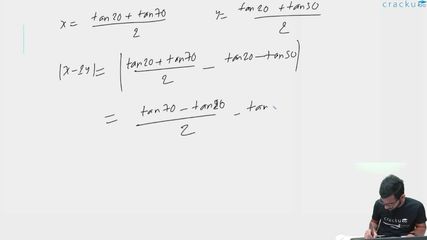
If $$\tan\left(\frac{\pi}{9}\right), x, \tan\left(\frac{7\pi}{18}\right)$$ are in arithmetic progression and $$\tan\left(\frac{\pi}{9}\right), y, \tan\left(\frac{5\pi}{18}\right)$$ are also in arithmetic progression, then $$|x - 2y|$$ is equal to:
We have that $$\tan\left(\frac{\pi}{9}\right),\,x,\,\tan\left(\frac{7\pi}{18}\right)$$ form an arithmetic progression, so by the definition of an A.P. the middle term is the average of the other two. Hence
$$2x=\tan\left(\frac{\pi}{9}\right)+\tan\left(\frac{7\pi}{18}\right).$$
Dividing by 2 we obtain
$$x=\frac{\tan\left(\frac{\pi}{9}\right)+\tan\left(\frac{7\pi}{18}\right)}{2}.$$
In the same way, the numbers $$\tan\left(\frac{\pi}{9}\right),\,y,\,\tan\left(\frac{5\pi}{18}\right)$$ are in arithmetic progression, so
$$2y=\tan\left(\frac{\pi}{9}\right)+\tan\left(\frac{5\pi}{18}\right)$$
and therefore
$$y=\frac{\tan\left(\frac{\pi}{9}\right)+\tan\left(\frac{5\pi}{18}\right)}{2}.$$
To handle these expressions we set
$$t=\tan\left(\frac{\pi}{9}\right)=\tan 20^{\circ}.$$
The angle $$\frac{7\pi}{18}=70^{\circ}$$ is the complement of $$20^{\circ}$$, so
$$\tan\left(\frac{7\pi}{18}\right)=\tan 70^{\circ}=\cot 20^{\circ}=\frac1{\tan 20^{\circ}}=\frac1t.$$
Thus
$$x=\frac{t+\dfrac1t}{2}.$$
Next we need $$\tan\left(\frac{5\pi}{18}\right)=\tan 50^{\circ}.$$ Let us denote
$$p=\tan 50^{\circ}.$$
Because $$70^{\circ}=50^{\circ}+20^{\circ},$$ we can apply the tangent addition formula
$$\tan(A+B)=\frac{\tan A+\tan B}{1-\tan A\,\tan B}.$$
Taking $$A=50^{\circ}$$ and $$B=20^{\circ},$$ we have
$$\tan 70^{\circ}=\frac{\tan 50^{\circ}+\tan 20^{\circ}}{1-\tan 50^{\circ}\tan 20^{\circ}}.$$
Substituting the symbols just introduced, this becomes
$$\frac1t=\frac{p+t}{1-pt}.$$
Cross-multiplying gives
$$t(p+t)=1-pt.$$
Expanding and bringing all terms to one side we get
$$tp+t^{2}=1-pt,$$
$$tp+pt+t^{2}=1,$$
$$2pt+t^{2}=1.$$
Solving for $$p$$ we find
$$p=\frac{1-t^{2}}{2t}.$$
Now we can write $$y$$ solely in terms of $$t$$:
$$y=\frac{t+p}{2}=\frac{t+\dfrac{1-t^{2}}{2t}}{2}.$$
It is more convenient to work directly with $$2y$$, because $$|x-2y|$$ appears in the question. We have from earlier
$$2y=t+p=t+\frac{1-t^{2}}{2t}.$$
Next we compute the required difference. Starting from the expression for $$x$$ we write
$$x-2y=\frac{t+\dfrac1t}{2}-\left(t+\frac{1-t^{2}}{2t}\right).$$
To combine terms we bring everything to a common denominator $$2t$$:
$$x-2y=\frac{t^{2}+1}{2t}-\frac{2t^{2}+1-t^{2}}{2t}.$$
Simplifying the numerator of the second fraction gives
$$2t^{2}+1-t^{2}=t^{2}+1,$$
so that
$$x-2y=\frac{t^{2}+1}{2t}-\frac{t^{2}+1}{2t}=0.$$
Hence
$$|x-2y|=|0|=0.$$
Hence, the correct answer is Option C.
Was this solution helpful?
Click on the Email ☝️ to Watch the Video Solution
Create a FREE account and get:
_1.webp)

Educational materials for JEE preparation

Ask our AI anything

AI can make mistakes. Please verify important information.
AI can make mistakes. Please verify important information.
