
Join Our JEE Preparation Group
Prep with like-minded aspirants; Get access to free daily tests and study material.
Sign in
Please select an account to continue using cracku.in
↓ →
Join Our JEE Preparation Group
Prep with like-minded aspirants; Get access to free daily tests and study material.
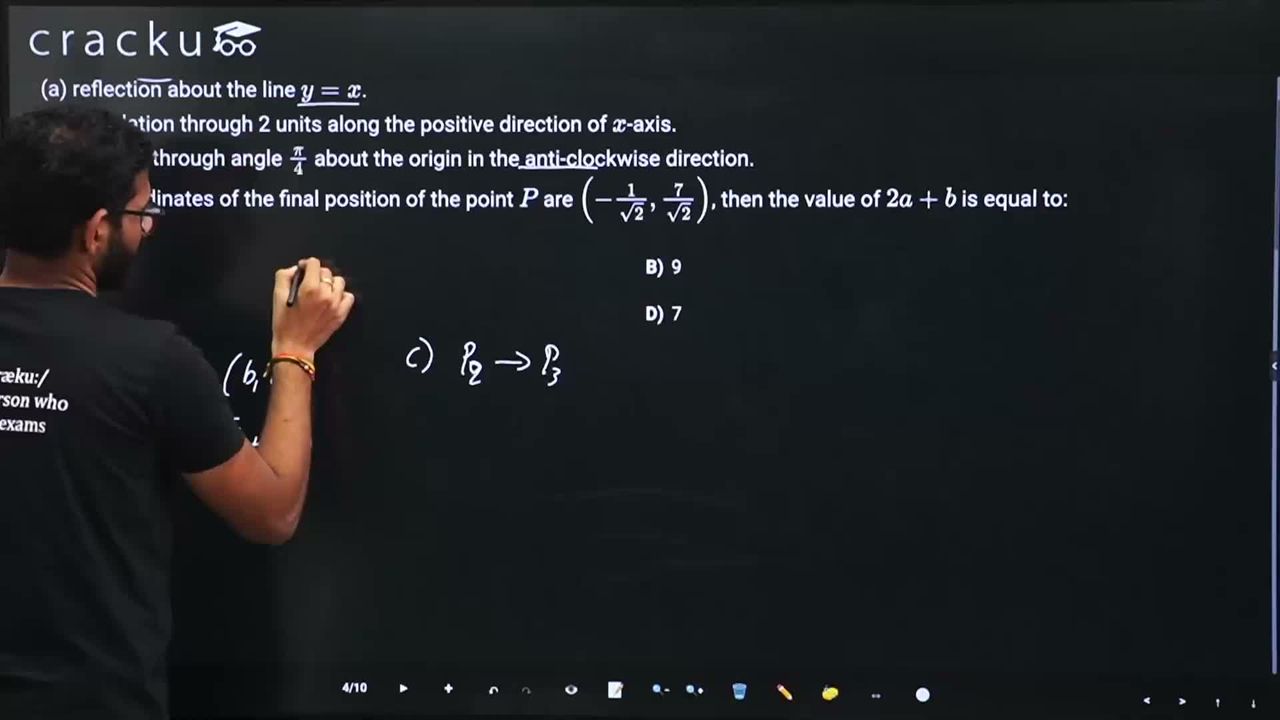
The point $$P(a, b)$$ undergoes the following three transformations successively:
(a) reflection about the line $$y = x$$.
(b) translation through 2 units along the positive direction of $$x$$-axis.
(c) rotation through angle $$\frac{\pi}{4}$$ about the origin in the anti-clockwise direction.
If the co-ordinates of the final position of the point $$P$$ are $$\left(-\frac{1}{\sqrt{2}}, \frac{7}{\sqrt{2}}\right)$$, then the value of $$2a + b$$ is equal to:
Let the original point be denoted by $$P(a,\,b)\,. $$ We shall follow the three prescribed transformations one after another and track the co-ordinates at every stage.
First, we perform a reflection about the line $$y=x.$$ For any point $$\bigl(x,\,y\bigr)$$, reflection in the line $$y=x$$ interchanges its co-ordinates. Hence
$$P(a, b)\;\longrightarrow\;P_1\bigl(b$$, $$\$$, $$a\bigr).$$
Next, we translate the point by 2 units along the positive $$x$$-axis. Translation along the positive $$x$$-direction by 2 units simply adds 2 to the $$x$$-coordinate while leaving the $$y$$-coordinate unchanged. Therefore
$$P_1\bigl(b,\,a\bigr)\;\longrightarrow\;P_2\bigl(b+2,\,a\bigr).$$
Now we rotate the point anticlockwise about the origin through an angle $$\dfrac{\pi}{4}\,.$$ For rotation of a point $$(x,\,y)$$ by an angle $$\theta$$ anticlockwise about the origin, the standard formula is
$$\bigl(x,\,y\bigr)\;\longrightarrow\;\Bigl(x\cos\theta-y\sin\theta,\;x\sin\theta+y\cos\theta\Bigr).$$
Here $$\theta=\dfrac{\pi}{4}$$, so $$\cos\theta=\dfrac{1}{\sqrt2}$$ and $$\sin\theta=\dfrac{1}{\sqrt2}\,.$$ Applying the formula to $$P_2\bigl(b+2,\,a\bigr)$$ we obtain the final point $$P_3(x_f,\,y_f):$$
$$\begin{aligned} x_f &= (b+2)\cos\frac{\pi}{4} - a\sin\frac{\pi}{4} = (b+2)\cdot\frac1{\sqrt2} - a\cdot\frac1{\sqrt2} = \frac{(b+2)-a}{\sqrt2},\\[4pt] y_f &= (b+2)\sin\frac{\pi}{4} + a\cos\frac{\pi}{4} = (b+2)\cdot\frac1{\sqrt2} + a\cdot\frac1{\sqrt2} = \frac{(b+2)+a}{\sqrt2}. \end{aligned}$$
We are told that the final co-ordinates are $$\left(-\dfrac1{\sqrt2},\;\dfrac7{\sqrt2}\right).$$ Hence
$$\frac{(b+2)-a}{\sqrt2}=-\frac1{\sqrt2}\quad\text{and}\quad \frac{(b+2)+a}{\sqrt2}=\frac7{\sqrt2}.$$
Multiplying both equations by $$\sqrt2$$ eliminates the denominator:
$$\begin{aligned} (b+2)-a &= -1,\\ (b+2)+a &= 7. \end{aligned}$$
Simplifying each equation gives
$$\begin{aligned} -b + a &= 3 \quad\Longrightarrow\quad a - b = 3,\\ a + b &= 5. \end{aligned}$$
Now we solve these simultaneous linear equations. Adding them yields
$$2a = 8 \;\;\Longrightarrow\;\; a = 4.$$
Substituting $$a=4$$ in $$a+b=5$$ gives
$$4 + b = 5 \;\;\Longrightarrow\;\; b = 1.$$
Finally, we compute the required expression $$2a + b$$:
$$2a + b = 2(4) + 1 = 8 + 1 = 9.$$
Hence, the correct answer is Option B.
Was this solution helpful?
Click on the Email ☝️ to Watch the Video Solution
Create a FREE account and get:
_1.webp)

Educational materials for JEE preparation

Ask our AI anything

AI can make mistakes. Please verify important information.
AI can make mistakes. Please verify important information.
