
Join Our JEE Preparation Group
Prep with like-minded aspirants; Get access to free daily tests and study material.
Sign in
Please select an account to continue using cracku.in
↓ →
Join Our JEE Preparation Group
Prep with like-minded aspirants; Get access to free daily tests and study material.
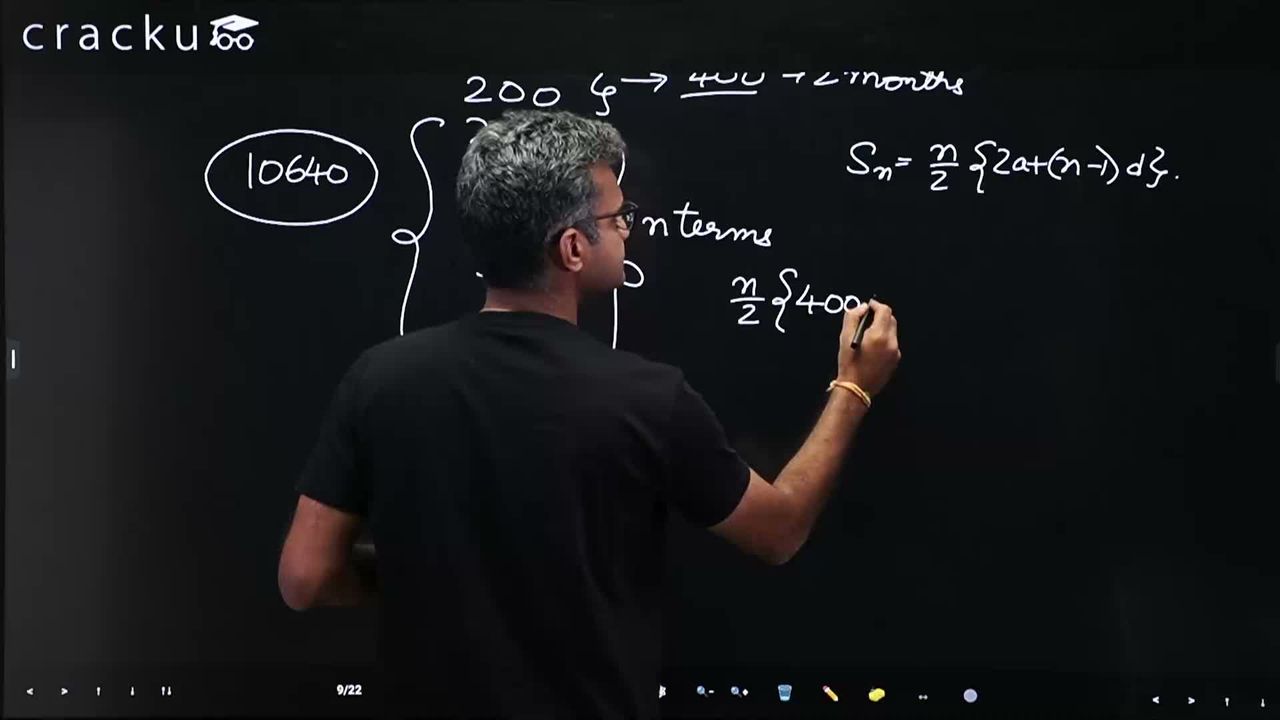
A man saves Rs. 200 in each of the first three months of his service. In each of the subsequent months his saving increases by Rs. 40 more than the saving of immediately previous month. His total saving from the start of service will be Rs. 11040 after:
For the first three months the man saves a fixed amount of Rs. 200 every month.
Month-wise saving pattern:
Month 1 = Rs. 200
Month 2 = Rs. 200
Month 3 = Rs. 200
From the 4th month onward each month’s saving is Rs. 40 more than the previous month, so an arithmetic progression (A.P.) begins with
First term of the A.P.: $$a_1 = 240$$ (saving in the 4th month)
Common difference: $$d = 40$$
Let the total number of months be $$n$$. For $$n \gt 3$$, the A.P. part has $$m = n - 3$$ terms.
Sum of the first three constant-saving months:
$$S_{\text{first 3}} = 3 \times 200 = 600$$
Sum of the A.P. for the next $$m$$ months:
Using $$S_m = \frac{m}{2}\bigl(2a_1 + (m-1)d\bigr)$$, we get
$$S_{\text{A.P.}} = \frac{m}{2}\bigl(2 \times 240 + (m-1)\,40\bigr)$$
$$= \frac{m}{2}\bigl(480 + 40m - 40\bigr)$$
$$= \frac{m}{2}\bigl(440 + 40m\bigr)$$
$$= 20m\,(11 + m)$$
Total saving after $$n$$ months:
$$S_{\text{total}} = 600 + 20m(11 + m)$$
Given $$S_{\text{total}} = 11040$$, substitute and solve for $$m$$:
$$600 + 20m(11 + m) = 11040$$
$$20m(11 + m) = 10440$$
Divide by 20:
$$m(m + 11) = 522$$
$$m^2 + 11m - 522 = 0$$
Quadratic formula:
Discriminant $$D = 11^2 + 4 \times 522 = 121 + 2088 = 2209 = 47^2$$
$$m = \frac{-11 \pm 47}{2}$$
Positive root: $$m = \frac{-11 + 47}{2} = \frac{36}{2} = 18$$ (negative root is inadmissible).
Therefore the total months are
$$n = m + 3 = 18 + 3 = 21$$
Hence the man will accumulate Rs. 11040 in 21 months.
Option C which is: 21 months
Was this solution helpful?
Click on the Email ☝️ to Watch the Video Solution
Create a FREE account and get:
_1.webp)

Educational materials for JEE preparation

Ask our AI anything

AI can make mistakes. Please verify important information.
AI can make mistakes. Please verify important information.


