
Join Our JEE Preparation Group
Prep with like-minded aspirants; Get access to free daily tests and study material.
Sign in
Please select an account to continue using cracku.in
↓ →
Join Our JEE Preparation Group
Prep with like-minded aspirants; Get access to free daily tests and study material.
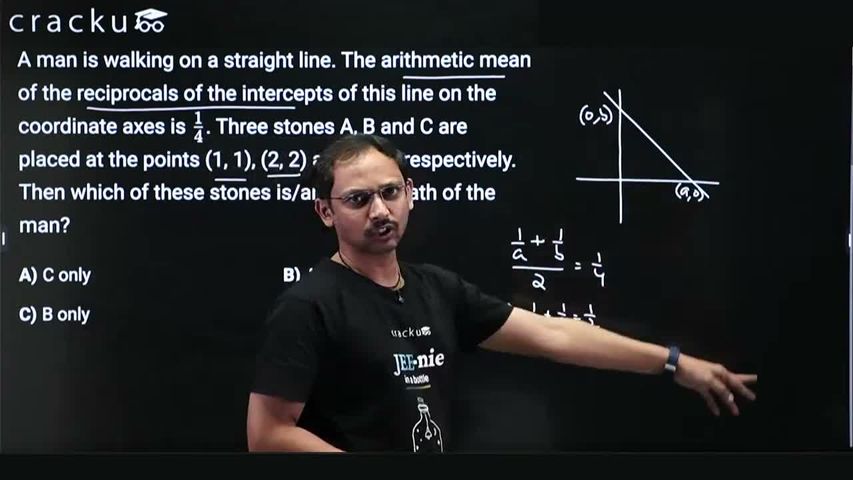
A man is walking on a straight line. The arithmetic mean of the reciprocals of the intercepts of this line on the coordinate axes is $$\frac{1}{4}$$. Three stones A, B and C are placed at the points (1, 1), (2, 2) and (4, 4) respectively. Then which of these stones is/are on the path of the man?
The equation of a line in intercept form is $$\frac{x}{a} + \frac{y}{b} = 1$$, where $$a$$ and $$b$$ are the intercepts on the coordinate axes.
The arithmetic mean of the reciprocals of the intercepts is given as $$\frac{1}{4}$$. So $$\frac{\frac{1}{a} + \frac{1}{b}}{2} = \frac{1}{4}$$, which gives $$\frac{1}{a} + \frac{1}{b} = \frac{1}{2}$$.
Now we check which of the given points lies on the line $$\frac{x}{a} + \frac{y}{b} = 1$$.
For point A$$(1, 1)$$: $$\frac{1}{a} + \frac{1}{b} = \frac{1}{2} \neq 1$$, so A does not lie on the line.
For point B$$(2, 2)$$: $$\frac{2}{a} + \frac{2}{b} = 2\left(\frac{1}{a} + \frac{1}{b}\right) = 2 \times \frac{1}{2} = 1$$. So B lies on the line.
For point C$$(4, 4)$$: $$\frac{4}{a} + \frac{4}{b} = 4\left(\frac{1}{a} + \frac{1}{b}\right) = 4 \times \frac{1}{2} = 2 \neq 1$$, so C does not lie on the line.
Hence, the correct answer is Option C.
Was this solution helpful?
Click on the Email ☝️ to Watch the Video Solution
Create a FREE account and get:
_1.webp)

Educational materials for JEE preparation

Ask our AI anything

AI can make mistakes. Please verify important information.
AI can make mistakes. Please verify important information.


