
Join Our JEE Preparation Group
Prep with like-minded aspirants; Get access to free daily tests and study material.
Sign in
Please select an account to continue using cracku.in
↓ →
Join Our JEE Preparation Group
Prep with like-minded aspirants; Get access to free daily tests and study material.
A light ray is incident perpendicular to one face of a $$90^\circ$$ prism and is totally internally reflected at the glass-air interface. If the angle of reflection is $$45^\circ$$, we conclude that the refractive index $$n$$
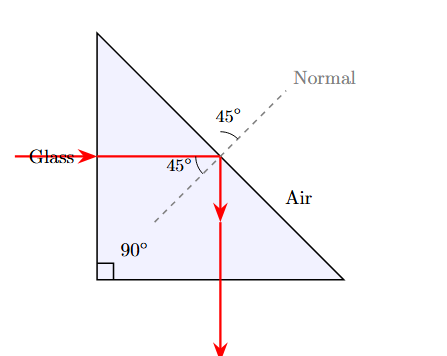
A light ray enters perpendicular to one face, meaning it passes into the prism undeviated. It then strikes the glass-air interface and is totally internally reflected.
The problem states that the angle of reflection is $$45^\circ$$. By the law of reflection, the angle of incidence $$i$$ at the glass-air interface must also be $$45^\circ$$.
For Total Internal Reflection (TIR) to occur, the angle of incidence ($$i$$) must be strictly greater than the critical angle ($$C$$) for the material.
$$ i > C $$
Taking the sine of both sides (since sine is an increasing function in the first quadrant):
$$ \sin i > \sin C $$
The critical angle relationship is $$\sin C = \frac{1}{n}$$, where $$n$$ is the refractive index of the glass (relative to air). Substitute this and $$i = 45^\circ$$:
$$ \sin(45^\circ) > \frac{1}{n} $$
$$ \frac{1}{\sqrt{2}} > \frac{1}{n} $$
Taking the reciprocal of both sides reverses the inequality:
$$ \sqrt{2} < n \implies n > \sqrt{2} $$
Option (B) $$n > \sqrt{2}$$
Was this solution helpful?
Create a FREE account and get:
_1.webp)

Educational materials for JEE preparation

Ask our AI anything

AI can make mistakes. Please verify important information.
AI can make mistakes. Please verify important information.
