
Join Our JEE Preparation Group
Prep with like-minded aspirants; Get access to free daily tests and study material.
Sign in
Please select an account to continue using cracku.in
↓ →
Join Our JEE Preparation Group
Prep with like-minded aspirants; Get access to free daily tests and study material.
Which one of the following sets of ions represents a collection of isoelectronic species?
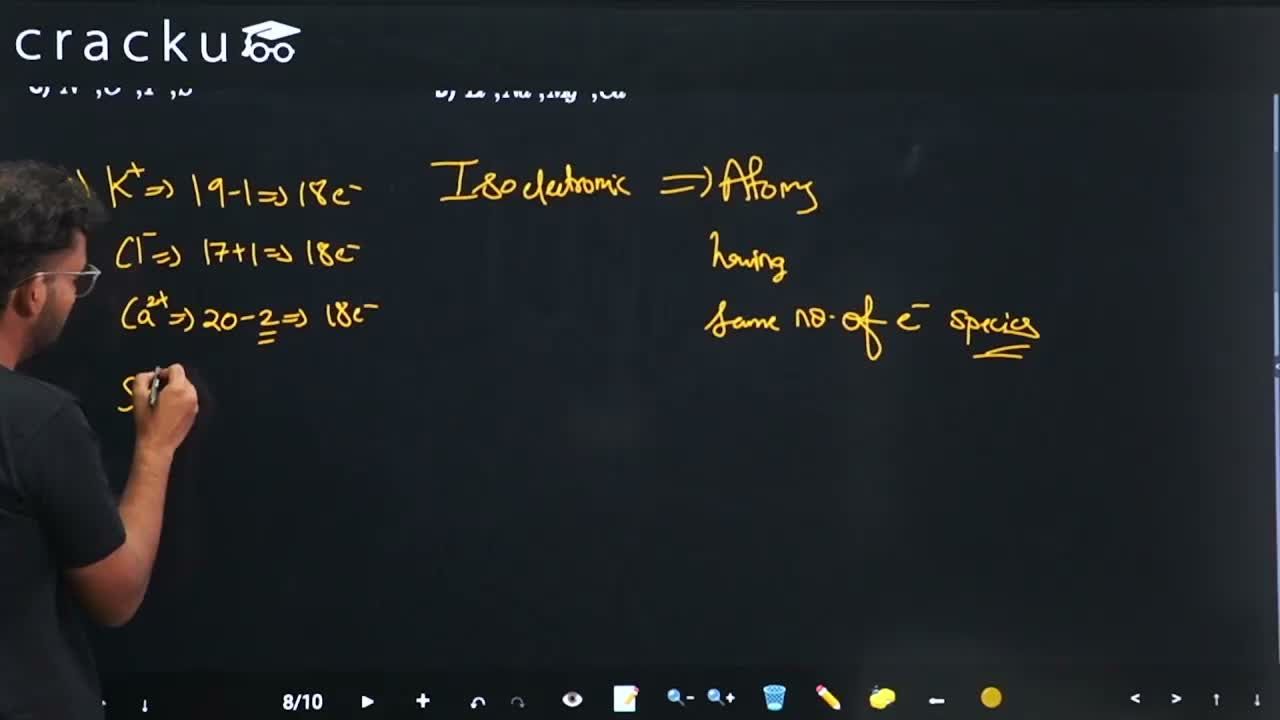
Species are called isoelectronic when each of them contains exactly the same number of electrons, irrespective of the nuclear charge.
For every ion, subtract the charge (if positive) or add the charge (if negative) from the atomic number to get the electron count.
Case A:
$$K^+ : 19 - 1 = 18$$ electrons
$$Cl^- : 17 + 1 = 18$$ electrons
$$Ca^{2+} : 20 - 2 = 18$$ electrons
$$Sc^{3+} : 21 - 3 = 18$$ electrons
All four ions possess $$18$$ electrons, so they are isoelectronic.
Case B:
$$Ba^{2+}: 56 - 2 = 54$$ e⁻, $$Sr^{2+}: 38 - 2 = 36$$ e⁻, $$K^+: 19 - 1 = 18$$ e⁻, $$S^{2-}: 16 + 2 = 18$$ e⁻
The electron counts differ (54, 36, 18), hence not isoelectronic.
Case C:
$$N^{3-}: 7 + 3 = 10$$ e⁻, $$O^{2-}: 8 + 2 = 10$$ e⁻, $$F^-: 9 + 1 = 10$$ e⁻, $$S^{2-}: 16 + 2 = 18$$ e⁻
The first three ions have 10 electrons, but $$S^{2-}$$ has 18; therefore the set is not isoelectronic.
Case D:
$$Li^+: 3 - 1 = 2$$ e⁻, $$Na^+: 11 - 1 = 10$$ e⁻, $$Mg^{2+}: 12 - 2 = 10$$ e⁻, $$Ca^{2+}: 20 - 2 = 18$$ e⁻
Again, the electron numbers differ (2, 10, 18), so this set also fails to be isoelectronic.
Only Option A gives the same electron count for every ion.
Hence, the correct answer is:
Option A which is: $$K^+, Cl^-, Ca^{2+}, Sc^{3+}$$
Was this solution helpful?
Click on the Email ☝️ to Watch the Video Solution
Create a FREE account and get:
_1.webp)

Educational materials for JEE preparation

Ask our AI anything

AI can make mistakes. Please verify important information.
AI can make mistakes. Please verify important information.
