Join Our JEE Preparation Group
Prep with like-minded aspirants; Get access to free daily tests and study material.
Sign in
Please select an account to continue using cracku.in
↓ →
Join Our JEE Preparation Group
Prep with like-minded aspirants; Get access to free daily tests and study material.
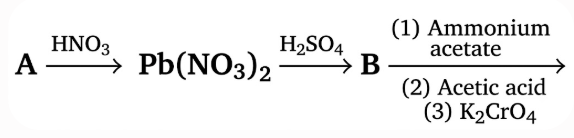
Lead(II) ions are identified in classical qualitative analysis by passing the precipitate successively through sulphide, sulphate and chromate tests. The colours obtained at every stage fix the formulae of the precipitates.
Case 1 : Treatment of the original lead(II) salt with $$H_2S$$ in acidic medium
$$Pb^{2+} + S^{2-} \rightarrow PbS\downarrow$$
Lead(II) sulphide forms as a black precipitate, so
$$A = PbS$$
Case 2 : Treating the black precipitate with dilute $$H_2SO_4$$
$$PbS + 2\,H_2SO_4 \rightarrow PbSO_4\downarrow + H_2S\uparrow + SO_2\uparrow + 2\,H_2O$$
Lead(II) sulphate is sparingly soluble and appears as a white precipitate, hence
$$B = PbSO_4$$
Case 3 : Adding an alkaline $$K_2CrO_4$$ (or $$Na_2CrO_4$$) solution to the white precipitate
$$Pb^{2+}_{(aq)} + CrO_4^{2-} \rightarrow PbCrO_4\downarrow$$
The insoluble bright-yellow solid obtained is lead(II) chromate, therefore
$$C = PbCrO_4$$
Thus the correct identification is:
A - $$PbS$$, B - $$PbSO_4$$, C - $$PbCrO_4$$
The only option that lists this sequence is
Option D which is: $$PbS,\,PbSO_{4},\,PbCrO_{4}$$
Was this solution helpful?
Create a FREE account and get:
_1.webp)

Educational materials for JEE preparation

Ask our AI anything

AI can make mistakes. Please verify important information.
AI can make mistakes. Please verify important information.