
Join Our JEE Preparation Group
Prep with like-minded aspirants; Get access to free daily tests and study material.
Sign in
Please select an account to continue using cracku.in
↓ →
Join Our JEE Preparation Group
Prep with like-minded aspirants; Get access to free daily tests and study material.
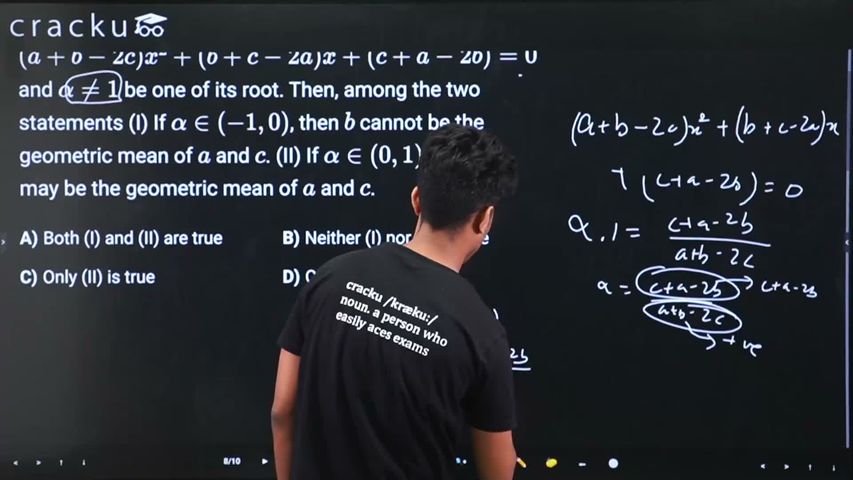
For $$0 \lt c \lt b \lt a$$, let $$(a + b - 2c)x^2 + (b + c - 2a)x + (c + a - 2b) = 0$$ and $$\alpha \neq 1$$ be one of its root. Then, among the two statements (I) If $$\alpha \in (-1, 0)$$, then $$b$$ cannot be the geometric mean of $$a$$ and $$c$$. (II) If $$\alpha \in (0, 1)$$, then $$b$$ may be the geometric mean of $$a$$ and $$c$$.
The sum of the coefficients of $$(a+b-2c)x^2 + (b+c-2a)x + (c+a-2b) = 0$$ is $$0$$, meaning $$x = 1$$ is one root.
The product of roots gives the other root $$\alpha$$:
$$\alpha \cdot 1 = \frac{c+a-2b}{a+b-2c} \implies \alpha = \frac{a+c-2b}{a+b-2c}$$
Given $$0 < c < b < a$$:
1. By AM-GM inequality, $$b < \frac{a+c}{2} \implies a+c-2b > 0$$ (Numerator is positive).
2. Since $$b > c$$, $$a+b-2c > a+c-2c = a-c > 0$$ (Denominator is positive).
Thus, $$\alpha > 0$$.
3. Comparing numerator and denominator: $$\text{Num} - \text{Den} = 3(c-b) < 0 \implies \alpha < 1$$.
Since $$b = \sqrt{ac} \implies \alpha \in (0, 1)$$:
• Statement (I) is True (if $$\alpha \in (-1,0)$$, $$b$$ cannot be the GM).
• Statement (II) is True (if $$\alpha \in (0,1)$$, $$b$$ can be the GM).
Was this solution helpful?
Click on the Email ☝️ to Watch the Video Solution
Create a FREE account and get:
_1.webp)

Educational materials for JEE preparation

Ask our AI anything

AI can make mistakes. Please verify important information.
AI can make mistakes. Please verify important information.
