
Join Our JEE Preparation Group
Prep with like-minded aspirants; Get access to free daily tests and study material.
Sign in
Please select an account to continue using cracku.in
↓ →
Join Our JEE Preparation Group
Prep with like-minded aspirants; Get access to free daily tests and study material.
The sum of the series $$\frac{1}{1 - 3 \cdot 1^2 + 1^4} + \frac{2}{1 - 3 \cdot 2^2 + 2^4} + \frac{3}{1 - 3 \cdot 3^2 + 3^4} + \ldots$$ up to 10 terms is
The general term of the series can be written as:
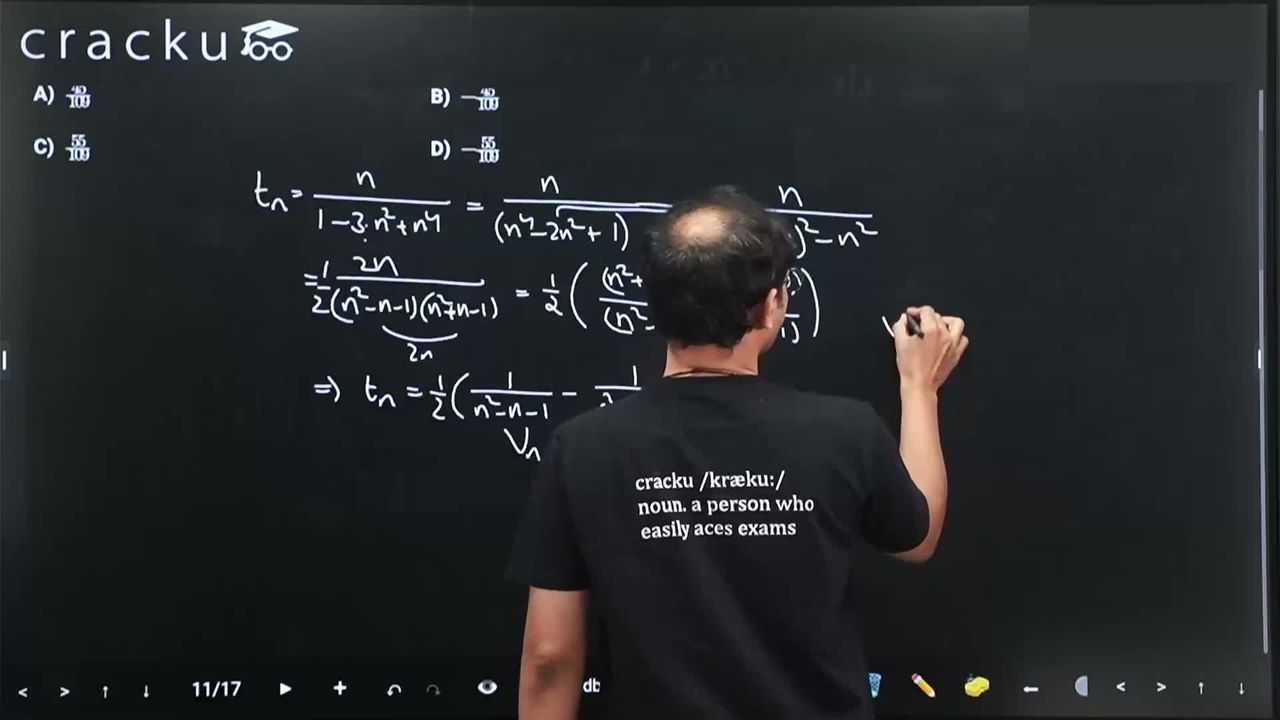
$$T_n = \frac{n}{1 - 3n^2 + n^4}$$
First, let's factor the denominator by completing the square:
$$n^4 - 3n^2 + 1 = n^4 - 2n^2 + 1 - n^2$$ $$= (n^2 - 1)^2 - n^2$$
Using the identity $$a^2 - b^2 = (a-b)(a+b)$$:
$$= (n^2 - 1 - n)(n^2 - 1 + n) = (n^2 - n - 1)(n^2 + n - 1)$$
Now, rewrite $$T_n$$ using these factors. Notice that the difference between the two terms in the denominator is $$(n^2 + n - 1) - (n^2 - n - 1) = 2n$$, which is twice our numerator. We can use this to split the term into partial fractions:
$$T_n = \frac{n}{(n^2 - n - 1)(n^2 + n - 1)}$$
$$T_n = \frac{1}{2} \left[ \frac{2n}{(n^2 - n - 1)(n^2 + n - 1)} \right]$$
$$T_n = \frac{1}{2} \left[ \frac{(n^2 + n - 1) - (n^2 - n - 1)}{(n^2 - n - 1)(n^2 + n - 1)} \right]$$
$$T_n = \frac{1}{2} \left[ \frac{1}{n^2 - n - 1} - \frac{1}{n^2 + n - 1} \right]$$
This forms a telescoping series. Notice that if we let $$V_n = \frac{1}{n^2 - n - 1}$$, then the next term $$V_{n+1}$$ is:
$$V_{n+1} = \frac{1}{(n+1)^2 - (n+1) - 1} = \frac{1}{n^2 + 2n + 1 - n - 1 - 1} = \frac{1}{n^2 + n - 1}$$
So, $$T_n = \frac{1}{2}(V_n - V_{n+1})$$.
Summing up to 10 terms:
$$S_{10} = \sum_{n=1}^{10} T_n = \frac{1}{2} [ (V_1 - V_2) + (V_2 - V_3) + \dots + (V_{10} - V_{11}) ]$$
Most terms cancel out, leaving just the first and last terms:
$$S_{10} = \frac{1}{2} (V_1 - V_{11})$$
Substitute $$n=1$$ and $$n=11$$ to find $$V_1$$ and $$V_{11}$$:
Finally, calculate the sum:
$$S_{10} = \frac{1}{2} \left( -1 - \frac{1}{109} \right) = \frac{1}{2} \left( \frac{-109 - 1}{109} \right) = \frac{1}{2} \left( \frac{-110}{109} \right) = -\frac{55}{109}$$
Was this solution helpful?
Click on the Email ☝️ to Watch the Video Solution
Create a FREE account and get:
_1.webp)

Educational materials for JEE preparation

Ask our AI anything

AI can make mistakes. Please verify important information.
AI can make mistakes. Please verify important information.
