
Join Our JEE Preparation Group
Prep with like-minded aspirants; Get access to free daily tests and study material.
Sign in
Please select an account to continue using cracku.in
↓ →
Join Our JEE Preparation Group
Prep with like-minded aspirants; Get access to free daily tests and study material.
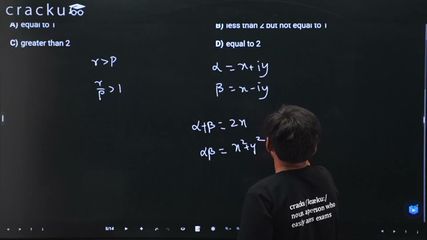
Let $$p, q, r \in R$$ and $$r > p > 0$$. If the quadratic equation $$px^2 + qx + r = 0$$ has two complex roots $$\alpha$$ and $$\beta$$, then $$|\alpha| + |\beta|$$ is
For the quadratic equation $$px^2 + qx + r = 0$$, with $$p,q,r \in \mathbb{R}$$ and $$p \gt 0$$, the sum and product of its roots $$\alpha , \beta$$ are given by Vieta’s relations:
$$\alpha + \beta = -\frac{q}{p}, \qquad \alpha \beta = \frac{r}{p} \quad -(1)$$
The statement says the two roots are complex. For a quadratic with real coefficients, this means the roots occur as complex conjugates. Hence we may write
$$\alpha = x + iy, \quad \beta = x - iy, \qquad y \neq 0 \quad (x,y \in \mathbb{R}).$$
Because they are conjugates, both roots have the same modulus:
$$|\alpha| = |\beta| = \sqrt{x^2 + y^2}. \quad -(2)$$
Using the product relation from $$(1)$$,
$$x^2 + y^2 = \alpha \beta = \frac{r}{p}. \quad -(3)$$
Substituting $$(3)$$ in $$(2)$$,
$$|\alpha| = |\beta| = \sqrt{\frac{r}{p}}.$$
Therefore the required sum of moduli is
$$|\alpha| + |\beta| = 2\sqrt{\frac{r}{p}}. \quad -(4)$$
The condition $$r \gt p \gt 0$$ gives
$$\frac{r}{p} \gt 1 \;\; \Longrightarrow \;\; \sqrt{\frac{r}{p}} \gt 1.$$
Multiplying by $$2$$, we obtain
$$|\alpha| + |\beta| = 2\sqrt{\frac{r}{p}} \gt 2. \quad -(5)$$
Equality with $$2$$ would require $$r = p$$, which contradicts $$r \gt p$$, and equality with $$1$$ is impossible because $$\sqrt{r/p} \gt 1$$. Thus $$|\alpha| + |\beta|$$ is strictly greater than $$2$$.
Hence the correct choice is:
Option C which is: greater than 2.
Was this solution helpful?
Click on the Email ☝️ to Watch the Video Solution
Create a FREE account and get:
_1.webp)

Educational materials for JEE preparation

Ask our AI anything

AI can make mistakes. Please verify important information.
AI can make mistakes. Please verify important information.
