
Join Our JEE Preparation Group
Prep with like-minded aspirants; Get access to free daily tests and study material.
Sign in
Please select an account to continue using cracku.in
↓ →
Join Our JEE Preparation Group
Prep with like-minded aspirants; Get access to free daily tests and study material.
Given below are two statements:
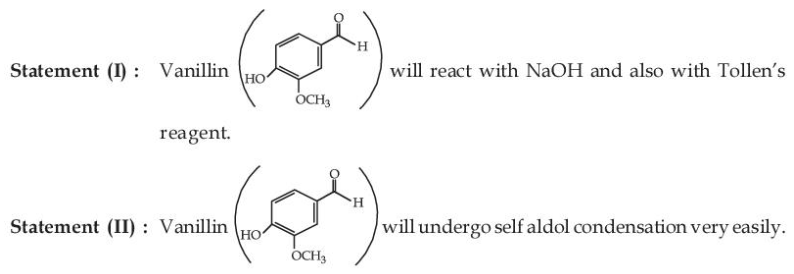
In the light of the above statements, choose the most appropriate answer from the options given below:
Vanillin contains the following functional groups:
Statement (I)
Vanillin reacts with $$NaOH$$ because it contains a phenolic $$-OH$$ group. Phenols are acidic in nature and form sodium phenoxide salts with aqueous sodium hydroxide.
Vanillin also reacts with Tollen's reagent because it contains an aldehyde group. Aldehydes reduce Tollen's reagent to produce a silver mirror.
Hence, Statement (I) is correct.
Statement (II)
Aldol condensation requires the presence of at least one $$\alpha$$-hydrogen atom adjacent to the carbonyl group.
In vanillin, the aldehyde group is directly attached to the benzene ring. The carbon adjacent to the carbonyl group is a ring carbon and does not possess any hydrogen atom.
Therefore, vanillin does not contain any $$\alpha$$-hydrogen and cannot undergo self aldol condensation.
Instead, compounds lacking $$\alpha$$-hydrogens generally undergo Cannizzaro reaction under strongly basic conditions.
Hence, Statement (II) is incorrect.
Therefore, Statement (I) is correct, but Statement (II) is incorrect.
Hence, the correct answer is the option stating:
$$\boxed{\text{Statement I is correct and Statement II is incorrect}}$$
Was this solution helpful?
Create a FREE account and get:
_1.webp)

Educational materials for JEE preparation

Ask our AI anything

AI can make mistakes. Please verify important information.
AI can make mistakes. Please verify important information.


