
Join Our JEE Preparation Group
Prep with like-minded aspirants; Get access to free daily tests and study material.
Sign in
Please select an account to continue using cracku.in
↓ →
Join Our JEE Preparation Group
Prep with like-minded aspirants; Get access to free daily tests and study material.
Among $$SO_2$$, $$NF_3$$, $$NH_3$$, $$XeF_2$$, $$ClF_3$$ and $$SF_4$$, the hybridization of the molecule with non-zero dipole moment and highest number of lone pairs of electrons on the central atom is:
We must locate, from the given list, the molecule that satisfies two conditions:
• its dipole moment $$\mu$$ is non-zero,
• its central atom possesses the greatest possible number of lone pairs.
List of species with the data required (use VSEPR rules):
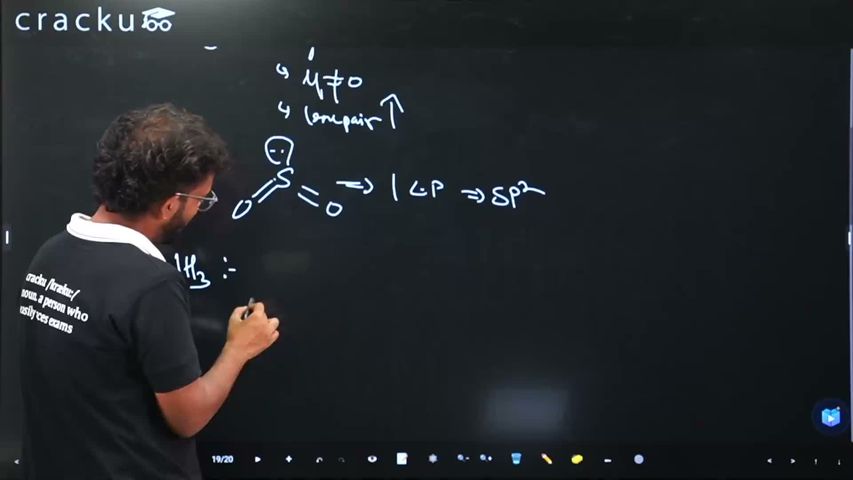
Case 1: $$SO_2$$ - Structure is angular (bent).
Hybridization of S: $$sp^2$$ (AX2E).
Lone pairs on S: 1.
Dipole moment: non-zero (bent shape).
Case 2: $$NF_3$$ - Pyramidal (AX3E).
Hybridization of N: $$sp^3$$.
Lone pairs on N: 1.
Dipole moment: non-zero.
Case 3: $$NH_3$$ - Also pyramidal (AX3E).
Hybridization of N: $$sp^3$$.
Lone pairs on N: 1.
Dipole moment: non-zero.
Case 4: $$XeF_2$$ - Linear (AX2E3).
Hybridization of Xe: $$sp^3d$$.
Lone pairs on Xe: 3 (highest so far).
Dipole moment: $$\mu = 0$$, because the axial $$\mathrm{Xe-F}$$ bonds are colinear and cancel.
Case 5: $$ClF_3$$ - T-shaped (AX3E2).
Hybridization of Cl: $$sp^3d$$.
Lone pairs on Cl: 2.
Dipole moment: non-zero (T-shape is not symmetrical enough for cancellation).
Case 6: $$SF_4$$ - See-saw (AX4E).
Hybridization of S: $$sp^3d$$.
Lone pairs on S: 1.
Dipole moment: non-zero.
Among the systems having non-zero dipole moment, the largest number of lone pairs is 2 (present in $$ClF_3$$). All other dipolar molecules posses only 1 lone pair, while $$XeF_2$$—though it has 3 lone pairs—has $$\mu = 0$$ and therefore does not meet the first criterion.
Therefore the required molecule is $$ClF_3$$.
Hybridization of the central atom in $$ClF_3$$ is $$sp^3d$$.
Hence, the correct option is Option D, $$sp^3d$$.
Was this solution helpful?
Click on the Email ☝️ to Watch the Video Solution
Create a FREE account and get:
_1.webp)

Educational materials for JEE preparation

Ask our AI anything

AI can make mistakes. Please verify important information.
AI can make mistakes. Please verify important information.


