
Join Our JEE Preparation Group
Prep with like-minded aspirants; Get access to free daily tests and study material.
Sign in
Please select an account to continue using cracku.in
↓ →
Join Our JEE Preparation Group
Prep with like-minded aspirants; Get access to free daily tests and study material.
Given below are two statements:
Statement I: Compound (X), shown below, dissolves in $$NaHCO_{3}$$ solution and has two chiral carbon atoms
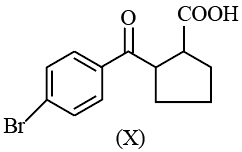
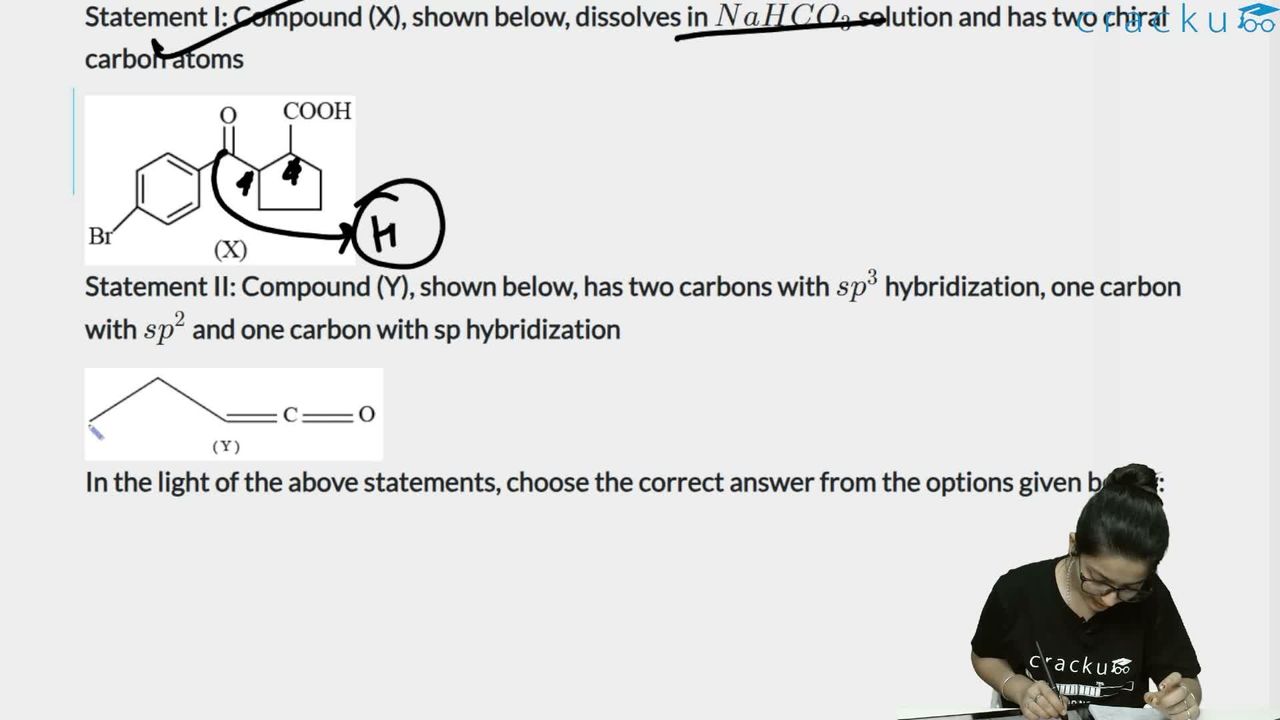
Statement II: Compound (Y), shown below, has two carbons with $$sp^{3}$$ hybridization, one carbon with $$sp^{2}$$ and one carbon with sp hybridization
%20slot%202.png)
In the light of the above statements, choose the correct answer from the options given below:
Given below are two statements regarding organic compounds (X) and (Y):
Statement I: Compound (X) dissolves in $$NaHCO_3$$ solution and has two chiral carbon atoms.
Statement II: Compound (Y) has two carbons with $$sp^3$$ hybridization, one carbon with $$sp^2$$ and one carbon with $$sp$$ hybridization.
In the light of the above statements, let us evaluate the validity of each statement:
Since both individual assertions are correct, we conclude that: Both Statement I and Statement II are true.
Therefore, the correct option is Both Statement I and Statement II are true.
Was this solution helpful?
Click on the Email ☝️ to Watch the Video Solution
Create a FREE account and get:
_1.webp)

Educational materials for JEE preparation

Ask our AI anything

AI can make mistakes. Please verify important information.
AI can make mistakes. Please verify important information.
