
Join Our JEE Preparation Group
Prep with like-minded aspirants; Get access to free daily tests and study material.
Sign in
Please select an account to continue using cracku.in
↓ →
Join Our JEE Preparation Group
Prep with like-minded aspirants; Get access to free daily tests and study material.
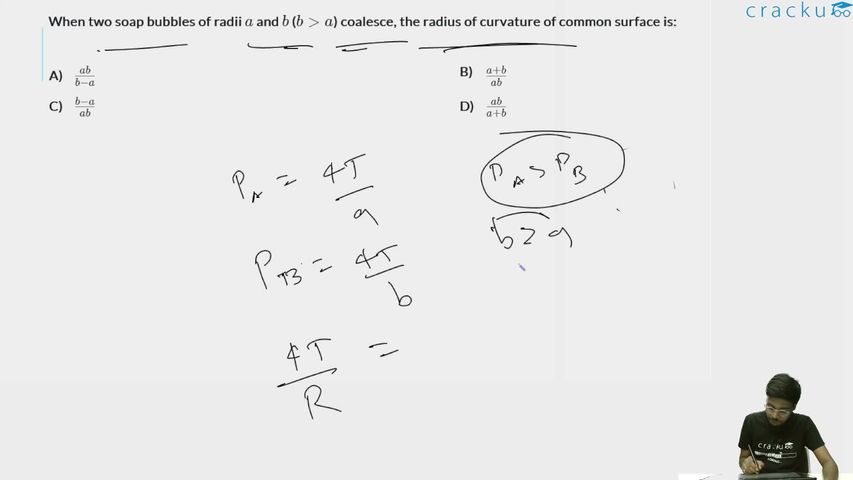
When two soap bubbles of radii $$a$$ and $$b$$ ($$b > a$$) coalesce, the radius of curvature of common surface is:
We need to determine the radius of curvature of the common interface formed when two soap bubbles of different radii coalesce under isothermal conditions.
A soap bubble has two free surfaces (inner and outer) in contact with air. The excess pressure ($$\Delta P$$) inside a soap bubble of radius $$r$$ with surface tension $$T$$ is given by the formula:
$$\Delta P = \frac{4T}{r}$$
Let the two individual soap bubbles have radii $$a$$ and $$b$$, with given condition $$b > a$$.
Since $$b > a$$, the internal pressure of the smaller bubble is greater than that of the larger bubble ($$P_a > P_b$$).
When the two bubbles coalesce and form a common internal boundary, the pressure difference across this shared wall determines its curvature.
Because the smaller bubble has a higher internal pressure, the common surface bulges into the larger bubble, becoming concave towards the smaller bubble.
The net excess pressure ($$\Delta P_{\text{common}}$$) acting across this common surface of radius $$R$$ is:
$$\Delta P_{\text{common}} = P_a - P_b$$
Substitute the structural excess pressure formulas into the balance equation:
$$\frac{4T}{R} = \frac{4T}{a} - \frac{4T}{b}$$
Dividing the entire equation by $$4T$$ simplifies it to:
$$\frac{1}{R} = \frac{1}{a} - \frac{1}{b}$$
Find a common denominator on the right-hand side:
$$\frac{1}{R} = \frac{b - a}{ab}$$
Taking the reciprocal to isolate $$R$$ gives:
$$R = \frac{ab}{b - a}$$
The radius of curvature of the common surface is $$\frac{ab}{b - a}$$, which corresponds to Option A.
Was this solution helpful?
Click on the Email ☝️ to Watch the Video Solution
Create a FREE account and get:
_1.webp)

Educational materials for JEE preparation

Ask our AI anything

AI can make mistakes. Please verify important information.
AI can make mistakes. Please verify important information.
