
Join Our JEE Preparation Group
Prep with like-minded aspirants; Get access to free daily tests and study material.
Sign in
Please select an account to continue using cracku.in
↓ →
Join Our JEE Preparation Group
Prep with like-minded aspirants; Get access to free daily tests and study material.
Two identical metal wires of thermal conductivities $$K_1$$ and $$K_2$$ respectively are connected in series. The effective thermal conductivity of the combination is:
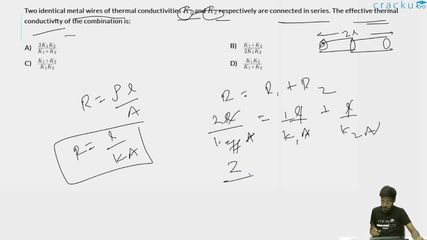
For two identical wires (same length $$l$$ and cross-sectional area $$A$$) connected in series, the total thermal resistance is the sum of individual resistances. The thermal resistance of each wire is $$R_i = \frac{l}{K_i A}$$, so the total resistance is $$R = \frac{l}{K_1 A} + \frac{l}{K_2 A}$$.
The effective conductivity $$K_{\text{eff}}$$ of the combination (total length $$2l$$, same area $$A$$) satisfies $$R = \frac{2l}{K_{\text{eff}} A}$$. Therefore $$\frac{2l}{K_{\text{eff}} A} = \frac{l}{K_1 A} + \frac{l}{K_2 A}$$.
Simplifying: $$\frac{2}{K_{\text{eff}}} = \frac{1}{K_1} + \frac{1}{K_2} = \frac{K_1 + K_2}{K_1 K_2}$$, which gives $$K_{\text{eff}} = \frac{2K_1 K_2}{K_1 + K_2}$$.
The correct answer is option 1: $$\frac{2K_1 K_2}{K_1 + K_2}$$.
Was this solution helpful?
Click on the Email ☝️ to Watch the Video Solution
Create a FREE account and get:
_1.webp)

Educational materials for JEE preparation

Ask our AI anything

AI can make mistakes. Please verify important information.
AI can make mistakes. Please verify important information.
