
Join Our JEE Preparation Group
Prep with like-minded aspirants; Get access to free daily tests and study material.
Sign in
Please select an account to continue using cracku.in
↓ →
Join Our JEE Preparation Group
Prep with like-minded aspirants; Get access to free daily tests and study material.
A mass $$M$$ hangs on a massless rod of length $$l$$ which rotates at a constant angular frequency. The mass $$M$$ moves with steady speed in a circular path of constant radius. Assume that the system is in steady circular motion with constant angular velocity $$\omega$$. The angular momentum of $$M$$ about point $$A$$ is $$L_A$$ which lies in the positive $$z$$ direction and the angular momentum of $$M$$ about $$B$$ is $$L_B$$. The correct statement for this system is:
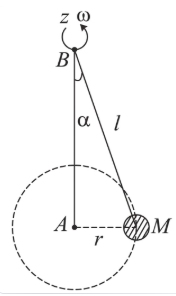
We need to analyze the characteristics of the angular momentum of a mass $$M$$ about two different reference points, $$A$$ and $$B$$, during steady conical pendulum-like circular motion.
Point $$A$$ lies at the center of the circular path of the mass $$M$$ along the vertical axis of rotation ($$z$$-axis).
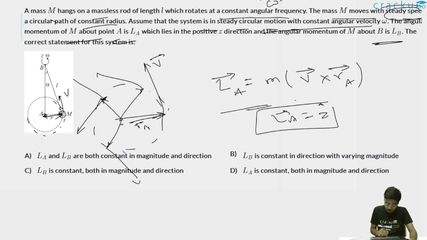
$$\vec{L}_A = \vec{r}_A \times \vec{p} = m(\vec{r}_A \times \vec{v})$$
Point $$B$$ is located on the vertical rotation axis but at a height above the plane of the circle (the suspension point of the rod).
$$\vec{L}_B = m(\vec{r}_B \times \vec{v})$$
Therefore, $$\vec{L}_A$$ remains constant both in magnitude and direction, while $$\vec{L}_B$$ changes its direction continuously. This corresponds to the correct choice on the page:
$$\vec{L}_A$$ is constant, both in magnitude and direction (Option D).
Was this solution helpful?
Click on the Email ☝️ to Watch the Video Solution
Create a FREE account and get:
_1.webp)

Educational materials for JEE preparation

Ask our AI anything

AI can make mistakes. Please verify important information.
AI can make mistakes. Please verify important information.
