
Join Our JEE Preparation Group
Prep with like-minded aspirants; Get access to free daily tests and study material.
Sign in
Please select an account to continue using cracku.in
↓ →
Join Our JEE Preparation Group
Prep with like-minded aspirants; Get access to free daily tests and study material.
A triangular plate is shown. A force $$\vec{F} = 4\hat{i} - 3\hat{j}$$ is applied at point $$P$$. The torque at point $$P$$ with respect to point $$O$$ and $$Q$$ are:
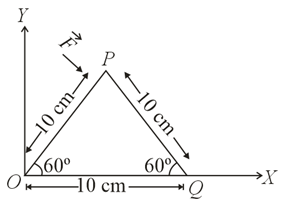
We need to determine the torque acting at point $$P$$ with respect to point $$O$$ and point $$Q$$ on an equilateral triangular plate.
From the diagram on the, the plate forms an equilateral triangle with side lengths of $$10\text{ cm} = 0.1\text{ m}$$ and interior angles of $$60^\circ$$. Let's establish the coordinate positions by placing the origin at point $$O(0,0)$$:
$$x_P = 10 \cos 60^\circ = 5\text{ cm} = 0.05\text{ m}$$
$$y_P = 10 \sin 60^\circ = 5\sqrt{3}\text{ cm} = 0.05\sqrt{3}\text{ m}$$
Therefore, the position vector of $$P$$ relative to $$O$$ is: $$\vec{r}_{P/O} = 0.05\hat{i} + 0.05\sqrt{3}\hat{j}$$
The applied force vector given in the problem is:
$$\vec{F} = 4\hat{i} - 3\hat{j}$$
Torque is defined by the cross product $$\vec{\tau} = \vec{r} \times \vec{F}$$:
$$\vec{\tau}_O = \vec{r}_{P/O} \times \vec{F} = \det \begin{bmatrix} \hat{i} & \hat{j} & \hat{k} \\ 0.05 & 0.05\sqrt{3} & 0 \\ 4 & -3 & 0 \end{bmatrix}$$
$$\vec{\tau}_O = \left[ 0.05 \times (-3) - 0.05\sqrt{3} \times 4 \right] \hat{k}$$
$$\vec{\tau}_O = \left( -0.15 - 0.20\sqrt{3} \right) \hat{k}\text{ N}\cdot\text{m}$$
Converting the units into $$\text{N}\cdot\text{cm}$$ to match the option formats (by multiplying the values by $$100$$):
$$\tau_O = -15 - 20\sqrt{3}$$
First, find the position vector of $$P$$ relative to $$Q$$:
$$\vec{r}_{P/Q} = \vec{r}_P - \vec{r}_Q = (0.05 - 0.1)\hat{i} + 0.05\sqrt{3}\hat{j} = -0.05\hat{i} + 0.05\sqrt{3}\hat{j}$$
Now, compute the cross product for torque about $$Q$$:
$$\vec{\tau}_Q = \vec{r}_{P/Q} \times \vec{F} = \det \begin{bmatrix} \hat{i} & \hat{j} & \hat{k} \\ -0.05 & 0.05\sqrt{3} & 0 \\ 4 & -3 & 0 \end{bmatrix}$$
$$\vec{\tau}_Q = \left[ (-0.05) \times (-3) - 0.05\sqrt{3} \times 4 \right] \hat{k}$$
$$\vec{\tau}_Q = \left( 0.15 - 0.20\sqrt{3} \right) \hat{k}\text{ N}\cdot\text{m}$$
Converting the units into $$\text{N}\cdot\text{cm}$$ gives:
$$\tau_Q = 15 - 20\sqrt{3}$$
The torque values at point $$P$$ relative to $$O$$ and $$Q$$ are $$-15 - 20\sqrt{3}$$ and $$15 - 20\sqrt{3}$$ respectively. This corresponds perfectly to Option A.
Was this solution helpful?
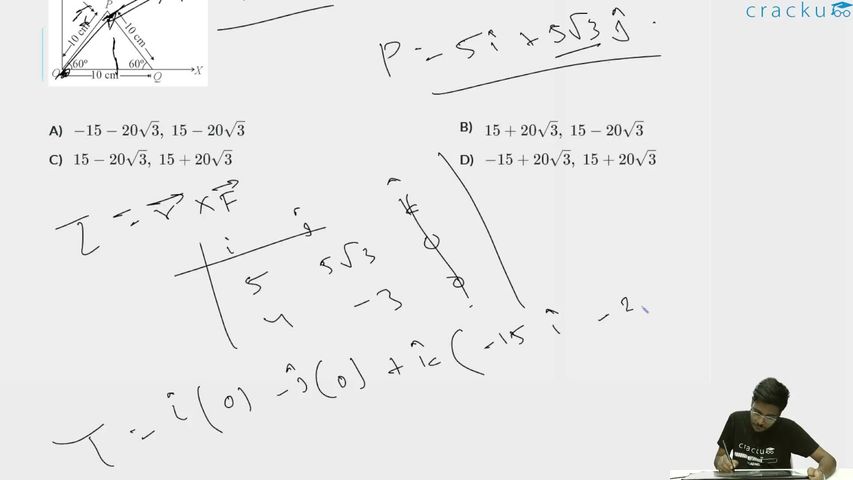
Click on the Email ☝️ to Watch the Video Solution
Create a FREE account and get:
_1.webp)

Educational materials for JEE preparation

Ask our AI anything

AI can make mistakes. Please verify important information.
AI can make mistakes. Please verify important information.
