
Join Our JEE Preparation Group
Prep with like-minded aspirants; Get access to free daily tests and study material.
Sign in
Please select an account to continue using cracku.in
↓ →
Join Our JEE Preparation Group
Prep with like-minded aspirants; Get access to free daily tests and study material.
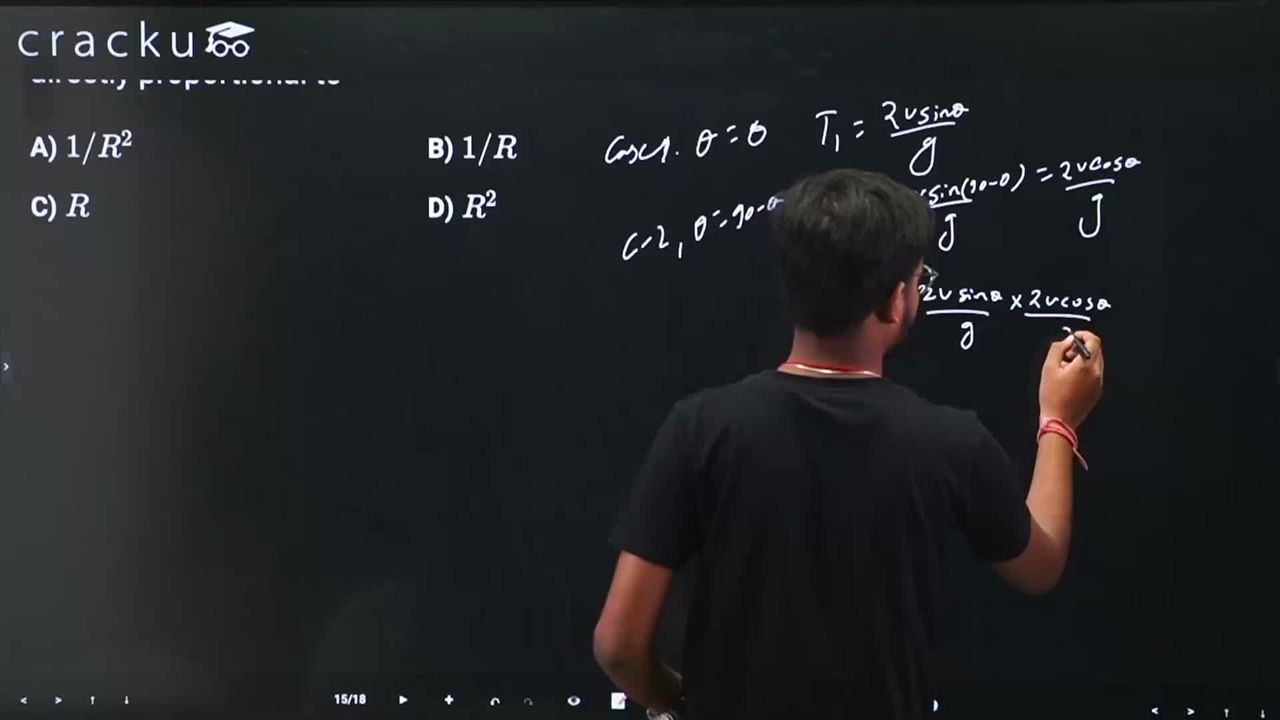
A projectile can have the same range $$R$$ for two angles of projection. If $$T_1$$ and $$T_2$$ be the time of flights in the two cases, then the product of the two time of flights is directly proportional to
A projectile launched with an initial velocity $$u$$ achieves the exact same horizontal range ($$R$$) at two distinct projection angles that are complementary to each other. Let these two angles be:
The standard formula for horizontal range ($$R$$) under gravitational acceleration ($$g$$) is:
$$R = \frac{u^2 \cdot \sin(2\theta)}{g} = \frac{2 \cdot u^2 \cdot \sin\theta \cdot \cos\theta}{g}$$
The total time of flight ($$T$$) for a projectile is given by the formula $$T = \frac{2 \cdot u \cdot \sin\alpha}{g}$$. We write down the specific time of flight expressions for both individual trajectories:
$$T_1 = \frac{2 \cdot u \cdot \sin\theta}{g}$$
$$T_2 = \frac{2 \cdot u \cdot \sin(90^\circ - \theta)}{g} = \frac{2 \cdot u \cdot \cos\theta}{g}$$
Now, let us calculate the product of the two times of flight ($$T_1 \cdot T_2$$):
$$T_1 \cdot T_2 = \left( \frac{2 \cdot u \cdot \sin\theta}{g} \right) \cdot \left( \frac{2 \cdot u \cdot \cos\theta}{g} \right)$$
$$T_1 \cdot T_2 = \frac{2}{g} \cdot \left( \frac{2 \cdot u^2 \cdot \sin\theta \cdot \cos\theta}{g} \right)$$
Notice that the grouped term inside the parentheses is the exact mathematical expression for the horizontal range ($$R$$) established in Step 1:
$$T_1 \cdot T_2 = \frac{2}{g} \cdot R$$
Since the factor $$\frac{2}{g}$$ is completely constant, we drop it to express the final scaling relationship:
$$T_1 \cdot T_2 \propto R$$
Concept Check: The product of the flight times directly tracks the horizontal range because one time profile captures the vertical component scaled by $$\sin\theta$$ and the other captures the horizontal configuration scaled by $$\cos\theta$$. Combined, their product tracks the cross-multiplied parameter $$\sin\theta \cdot \cos\theta$$, which defines horizontal displacement capacity.
Correct Option Key: Option C ($$R$$)
Was this solution helpful?
Click on the Email ☝️ to Watch the Video Solution
Create a FREE account and get:
_1.webp)

Educational materials for JEE preparation

Ask our AI anything

AI can make mistakes. Please verify important information.
AI can make mistakes. Please verify important information.
