
Join Our JEE Preparation Group
Prep with like-minded aspirants; Get access to free daily tests and study material.
Sign in
Please select an account to continue using cracku.in
↓ →
Join Our JEE Preparation Group
Prep with like-minded aspirants; Get access to free daily tests and study material.
Given below are two statements : Statement I : $$ CH_3 - O - CH_2 - Cl$$ will undergo $$S_N 1$$ reaction though it is a
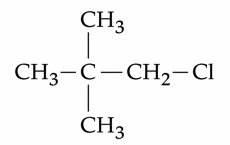
primary halide. Statement II :
will not undergo $$S_N 2$$ reaction very easily though it is a primary halide. In the light of the above statements,
choose the most appropriate answer from the options given below :
Consider the halide $$CH_3-O-CH_2-Cl$$ (chloromethyl methyl ether). Although the carbon bearing chlorine is formally primary, the adjacent oxygen atom strongly influences both $$S_N1$$ and $$S_N2$$ pathways.
Statement I : Tendency towards $$S_N1$$ reaction
1. In an $$S_N1$$ mechanism, the rate-determining step is heterolytic cleavage of the $$C-Cl$$ bond to give a carbocation.
2. Loss of $$Cl^-$$ from $$CH_3-O-CH_2-Cl$$ produces the carbocation $$CH_3-O-CH_2^+$$.
3. The lone pair on oxygen can overlap with the empty $$p$$ orbital on the carbocation, giving the resonance pair
$$CH_3-O-CH_2^+ \;\;\; \longleftrightarrow \;\;\; CH_3-O^+=CH_2$$
This neighbouring-group participation stabilises the carbocation far more than in an ordinary primary halide. Because the intermediate is resonance-stabilised, the energy barrier for ionisation is low and the compound readily follows an $$S_N1$$ pathway. Hence Statement I is correct.
Statement II : Reluctance towards $$S_N2$$ reaction
1. An $$S_N2$$ reaction requires backside attack of the nucleophile on the $$C-Cl$$ bond.
2. The same lone-pair donation that stabilises the carbocation also introduces partial $$C=O$$ double-bond character in the ground state. This raises the electron density on the carbon undergoing substitution, so the carbon is less electrophilic than in a typical primary halide.
3. In addition, the oxygen lone pairs create electronic (and a little steric) repulsion for an approaching nucleophile from the backside. As a result, the transition state for $$S_N2$$ is destabilised and the rate drops sharply compared with normal primary halides.
Therefore the compound “will not undergo $$S_N2$$ reaction very easily”, making Statement II correct.
Since both statements are correct, the appropriate choice is:
Option B which is: Both Statement I and Statement II are correct
Was this solution helpful?
Create a FREE account and get:
_1.webp)

Educational materials for JEE preparation

Ask our AI anything

AI can make mistakes. Please verify important information.
AI can make mistakes. Please verify important information.
