
Join Our JEE Preparation Group
Prep with like-minded aspirants; Get access to free daily tests and study material.
Sign in
Please select an account to continue using cracku.in
↓ →
Join Our JEE Preparation Group
Prep with like-minded aspirants; Get access to free daily tests and study material.
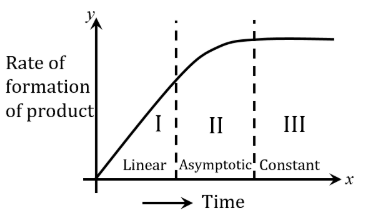
For certain chemical reaction X $$\to$$ Y, the rate of formation of product is plotted against the time as shown in the figure. The number of Correct statement/s from the following is ______
(A) Over all order of this reaction is one
(B) Order of this reaction can't be determined
(C) In region-I and III, the reaction is of first and zero order respectively
(D) In region-II, the reaction is of first order
(E) In region-II, the order of reaction is in the range of 0.1 to 0.9.
Correct Answer: 1
The plot of rate of formation of Y (ordinate) versus time (abscissa) shows three distinctly different portions, marked I, II and III.
Region I : the rate remains practically constant with time. A constant rate implies $$r = k[X]^0$$. Hence the reaction behaves as **zero-order** in this part.
Region III : the rate falls rapidly and the curve is an exponential decay. An exponential decrease with time is described by $$r = k[X]$$, i.e. **first-order** behaviour.
Region II : this connects the zero-order part to the first-order part. Here the rate is no longer perfectly horizontal (as in Region I) nor strictly exponential (as in Region III); it bends smoothly from the horizontal to the exponential fall. Such an intermediate curvature arises when the rate law is of the general form $$r = k[X]^n$$ with $$0 \lt n \lt 1$$. In other words, the instantaneous order in Region II is **fractional and lies between 0 and 1**, say 0.1 - 0.9.
Now we examine each statement:
(A) Overall order is one — incorrect, because different portions of the curve show different kinetic orders.
(B) Order cannot be determined — incorrect, the qualitative shape allows inference of the order in every region.
(C) Region I first-order and Region III zero-order — exactly the opposite of what the graph shows, so incorrect.
(D) Region II first-order — incorrect; Region II is not purely first-order.
(E) Region II has order between 0.1 and 0.9 — consistent with the fractional order deduced above, hence **correct**.
Therefore, exactly **one** statement (statement E) is correct.
Final answer : 1
Was this solution helpful?
Create a FREE account and get:
_1.webp)

Educational materials for JEE preparation

Ask our AI anything

AI can make mistakes. Please verify important information.
AI can make mistakes. Please verify important information.
