
Join Our JEE Preparation Group
Prep with like-minded aspirants; Get access to free daily tests and study material.
Sign in
Please select an account to continue using cracku.in
↓ →
Join Our JEE Preparation Group
Prep with like-minded aspirants; Get access to free daily tests and study material.
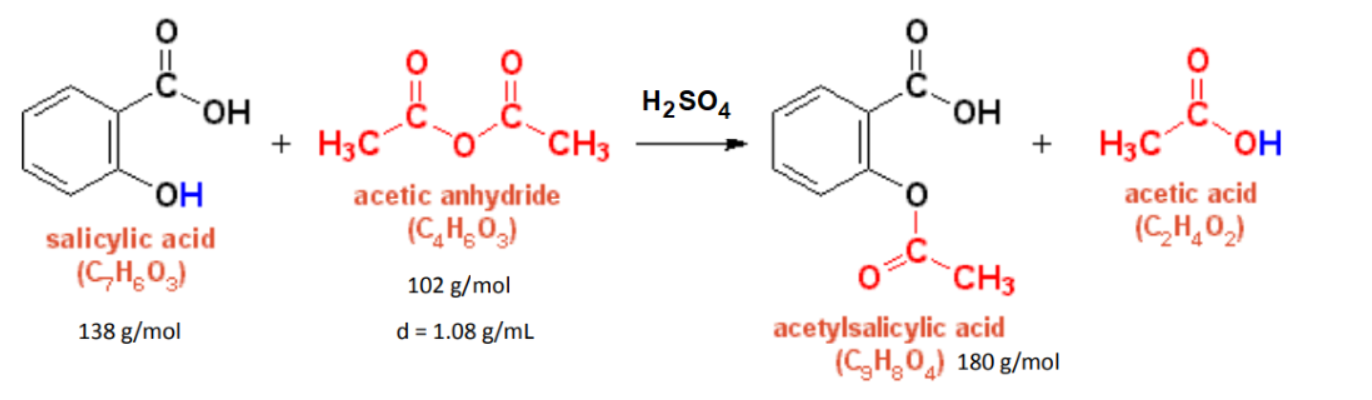
Aspirin (acetylsalicylic acid) is obtained by acetylating the phenolic -OH group of salicylic acid.
Step-1: Recall the required functional group change.
Salicylic acid, $$o\!-\!HO-C_6H_4-COOH$$, must acquire an acetyl ( $$CH_3CO-$$ ) group on the phenolic oxygen to give $$o\!-\!CH_3COO-C_6H_4-COOH$$.
Step-2: Choose a suitable acetylating reagent.
Common laboratory acetylating agents are acetic anhydride $$(CH_3CO)_2O$$ and acetyl chloride $$CH_3COCl$$. Acetic anhydride is preferred because it is less corrosive and its by-product is acetic acid, which is innocuous.
Step-3: Identify the catalyst.
The acetylation is an esterification; a few drops of concentrated $$H_2SO_4$$ protonate the carbonyl oxygen of acetic anhydride, increasing its electrophilicity and thus facilitating nucleophilic attack by the phenolic -OH of salicylic acid.
Overall reaction:
$$\text{Salicylic acid} + (CH_3CO)_2O \xrightarrow{H_2SO_4} \text{Aspirin} + CH_3COOH$$
Step-4: Analyse each option.
Option A: Salicylaldehyde lacks the carboxylic acid group and would yield an acetal, not aspirin → Incorrect.
Option B: Methanol is an alcohol; with salicylic acid it produces methyl salicylate (oil of wintergreen), not aspirin → Incorrect.
Option C: Salicylic acid + acetic anhydride + $$H_2SO_4$$ supplies exactly the reagent, acetylating agent, and catalyst required → Correct.
Option D: Cinnamic acid is a different substrate; acetylation would not generate the aspirin structure → Incorrect.
Hence the correct choice is:
Option C which is: Salicylic acid with acetic anhydride in presence of H$$_2$$SO$$_4$$.
Was this solution helpful?
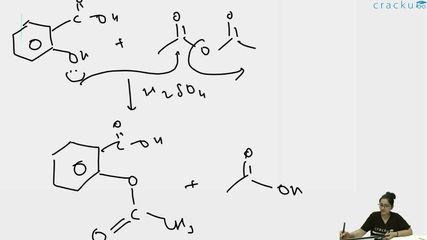
Click on the Email ☝️ to Watch the Video Solution
Create a FREE account and get:
_1.webp)

Educational materials for JEE preparation

Ask our AI anything

AI can make mistakes. Please verify important information.
AI can make mistakes. Please verify important information.
