
Join Our JEE Preparation Group
Prep with like-minded aspirants; Get access to free daily tests and study material.
Sign in
Please select an account to continue using cracku.in
↓ →
Join Our JEE Preparation Group
Prep with like-minded aspirants; Get access to free daily tests and study material.
Which of the following statements are true ?
(A) The subsidiary quantum number $$l$$ describes the shape of the orbital occupied by the electron.
(B)
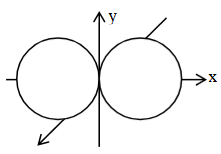
is the boundary diagram of the $$2p_x$$ orbital.
(C) The + and - signs in the wave function of the $$2p_x$$ orbital refer to charge.
(D) The wave function of $$2p_x$$ orbital is zero everywhere in the xy plane.
The subsidiary (azimuthal) quantum number $$l$$ determines the subshell in which an electron is present. Different values of $$l$$ correspond to different orbital shapes such as $$s$$, $$p$$, $$d$$, and $$f$$ orbitals. Therefore, $$l$$ determines the shape of the orbital.
Hence, Statement (A) is true.
The given boundary surface diagram represents a dumbbell-shaped orbital with its two lobes aligned along the $$x$$-axis. Such an orientation is characteristic of the $$2p_x$$ orbital.
Hence, Statement (B) is true.
The $$+$$ and $$-$$ signs shown on the two lobes of a $$p$$ orbital represent the phase (sign) of the wave function $$\psi$$. They do not indicate positive or negative electrical charge, since the entire electron cloud carries the same negative charge.
Hence, Statement (C) is false.
A $$2p_x$$ orbital has its nodal plane perpendicular to the $$x$$-axis, which is the $$yz$$ plane ($$x=0$$). The probability density is zero only on this plane and not on the $$xy$$ plane.
Hence, Statement (D) is false.
Therefore, only Statements (A) and (B) are correct.
Hence, the correct answer is Option (D): (A) and (B) only.
Was this solution helpful?
Create a FREE account and get:
_1.webp)

Educational materials for JEE preparation

Ask our AI anything

AI can make mistakes. Please verify important information.
AI can make mistakes. Please verify important information.


