
Join Our JEE Preparation Group
Prep with like-minded aspirants; Get access to free daily tests and study material.
Sign in
Please select an account to continue using cracku.in
↓ →
Join Our JEE Preparation Group
Prep with like-minded aspirants; Get access to free daily tests and study material.
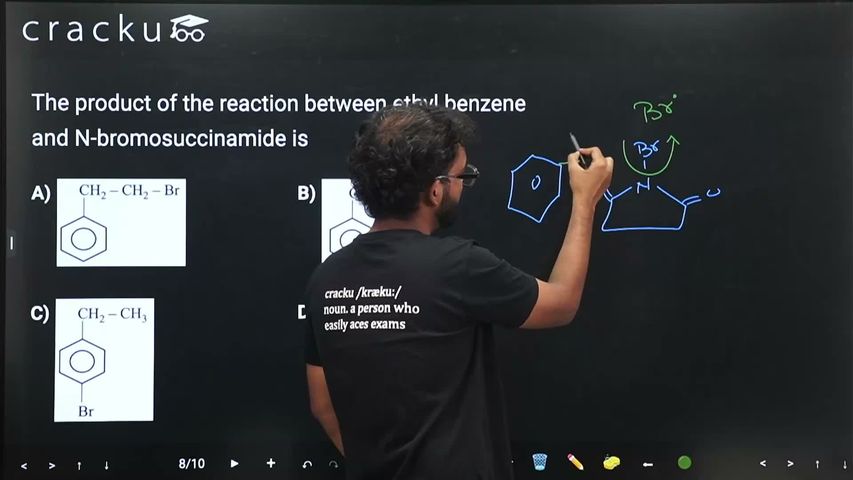
N-Bromosuccinimide (NBS) in the presence of light or a peroxide is a reagent for selective radical bromination at an allylic or benzylic position. It maintains a very low concentration of molecular $$Br_2$$ so that substitution (not addition) occurs.
Ethyl benzene is $$C_6H_5CH_2CH_3$$. The carbon that is directly attached to the ring (the $$CH_2$$ group) is a benzylic carbon. Benzylic radicals are strongly resonance-stabilised, so the hydrogen atoms on this carbon are the ones that react fastest with NBS.
Step-wise outline:
1. Abstraction of a benzylic H gives the benzylic radical $$C_6H_5\dot{C}HCH_3$$.
2. The radical is trapped by $$Br_2$$ (generated in situ from NBS) to give the benzylic bromide and a new $$Br\cdot$$ radical, propagating the chain.
The overall transformation is therefore
$$C_6H_5CH_2CH_3 \;\xrightarrow[\;h\nu\;]{\;NBS\;} C_6H_5CH(Br)CH_3 + \text{succinimide}$$
The product $$C_6H_5CH(Br)CH_3$$ is named 1-bromo-1-phenylethane (also called α-bromoethylbenzene).
Hence the correct choice is
Option D which is: 1-bromo-1-phenylethane.
Was this solution helpful?
Click on the Email ☝️ to Watch the Video Solution
Create a FREE account and get:
_1.webp)

Educational materials for JEE preparation

Ask our AI anything

AI can make mistakes. Please verify important information.
AI can make mistakes. Please verify important information.
