
Join Our JEE Preparation Group
Prep with like-minded aspirants; Get access to free daily tests and study material.
Sign in
Please select an account to continue using cracku.in
↓ →
Join Our JEE Preparation Group
Prep with like-minded aspirants; Get access to free daily tests and study material.
The dibromo compound [P] (molecular formula : $$C_{9}H_{10}Br_{2}$$) when heated with excess sodamide followed by treatment with dilute HO gives [Q]. On wanning [Q] with mercuric sulphate and
dilute sulphuric acid yield [R] which gives positive Iodofonn test but negative Tollen's test. The compound [P] is:
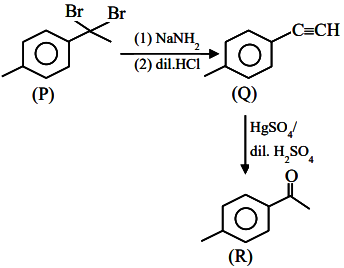
We need to determine the correct structure of the dibromo compound [P] ($$C_9H_{10}Br_2$$) based on its reaction sequence leading to compound [R].
Step 1: Conversion of [P] to [Q]
When the geminal dihalide [P] is heated with excess sodamide ($$\text{NaNH}_2$$), it undergoes a double dehydrohalogenation (elimination of two molecules of $$\text{HBr}$$) to yield a terminal alkyne [Q]. Treatment with dilute acid protonates the acetylide ion back to the alkyne form.
Step 2: Hydration of [Q] to [R]
Warming the terminal alkyne [Q] with mercuric sulfate ($$\text{HgSO}_4$$) and dilute sulfuric acid ($$\text{H}_2\text{SO}_4$$) causes Kucherov hydration (Markovnikov addition of water). The resulting enol tautomerizes into a stable methyl ketone [R].
Step 3: Characterization of [R]
From the reaction scheme shown, the structure of [R] is explicitly identified as 1-(3-methylphenyl)ethan-1-one (a methyl ketone with a meta-methyl group on the benzene ring).
Tracing back to the starting material, the geminal dibromo group must be located on the side chain alpha-carbon atom where the terminal alkyne and carbonyl group are formed.
Therefore, the original compound [P] is 1,1-dibromo-1-(3-methylphenyl)ethane.
Answer: Option B
Was this solution helpful?
Click on the Email ☝️ to Watch the Video Solution
Create a FREE account and get:
_1.webp)

Educational materials for JEE preparation

Ask our AI anything

AI can make mistakes. Please verify important information.
AI can make mistakes. Please verify important information.
